Some of us have been discussing the issues raised here, but in a somewhat different context. Thanks to the Northwest Labor Press for its reporting!
The standoff at North Dakota’s Standing Rock Sioux Reservation — with Indian tribes and supporters on one side, and police and private security for the Dakota Access Pipeline on the other – also finds labor union members on both sides.
North America’s Building Trades Unions and the AFL-CIO have come out in favor of the project moving forward, because it’s a big source of union jobs. But other labor organizations have declared support for pipeline protesters, and in Oregon and Washington, a number of union members have traveled to Standing Rock to take part in the massive protest encampment — a nonviolent uprising that has united Indian tribes nationwide.
Roben White — a retired union painter and former president of Painters Local 10 — is one of them. White is of mixed Lakota Sioux and Cheyenne ancestry on his father’s side, and he’s an enrolled member of the Oglala Lakota tribe at the Pine Ridge Indian Reservation in South Dakota. He’s also a staunch unionist who says he was pained to see unions take a stand he disagrees with.
The Standing Rock Sioux object to the pipeline chiefly because of the potential risk to their water supply. When complete, the Dakota Access Pipeline would pump 470,000 barrels a day of light crude oil through a 30-inch-wide, 1,172-mile-long pipeline from the Bakken Oil Fields of northwestern North Dakota through South Dakota and Iowa to refining facilities in Illinois. The pipeline’s route was originally supposed to cross the Missouri River just upstream from Bismarck, North Dakota, but because of concerns that an oil spill could wreck the city’s water supply, the route was changed to cross just upstream from the Standing Rock Sioux Reservation. The pipeline would cross half a mile north of the reservation, 92 feet underneath the Standing Rock Sioux water supply — Lake Oahe, a reservoir formed by a Missouri River dam.
Read the entire article here.
Thursday, December 15, 2016

Wednesday, December 14, 2016

Please Support The Striking Momentive Workers!
700+ workers in Waterford, NY are standing up to corporate greed. You can learn more about their strike and how you can help at momentiveworkers.com.
Tuesday, December 13, 2016
We Joined Another Rally To Save The Elliott State Forest Today

Photo from Facebook
A spirited group of people rallied once more to save the Elliot State Forest today. A crowd packed the State Land Board hearing held in Keizer and the issue got good media coverage today. I was once more moved and educated by the protests.
Speaking for myself, I find it difficult to think through pragmatic alternatives to the sale of the forest, but something deep inside of me revolts against the idea of logging and selling state lands to a logging company, or to any private corporation. That any form of privatization and environmental destruction can be seriously debated is outrageous. I object to the logic that says that the forest needs to provide funds and profits for human beings and to the feel-good view that the logging company involved is a local company and that that somehow makes logging a state forest okay. We put people and nature before profits and we're aware that multinational capital now influences local decision-making even when a multinational corporation does not own local companies.
On the other hand, it's hard to agree with the folks who say that there is no constituency supporting logging the Elliot State Forest. Testimony in support of logging came from Native American tribal representatives, the Oregon Education Association and the school boards today. Those are constituencies, and it's difficult for me to imagine fighting people of color and a progressive union. The idea that a bond could be floated to raise funding is a good one, but I can't imagine Governor Brown, who is emerging as an anti-environmental governor and as a liberal establishment leader, backing this. Brown has a liberal machine or coalition in place to back her as another state budget crisis unfolds, and that machine includes many people we ally with on other important issues.
I am also concerned that the necessary fights over environmental issues fall short on analysis and unity. It's hard to talk about saving the Elliott Forest and stopping the coal and LNG terminals with a budget shortfall staring at us and no inclusive solution at hand. We need something which holds on to all public services and land and unites all peoples' needs. It's ridiculous that any part of the education budget is tied to land usage. The defeat of Measure 97 and the absence of a state sales tax mean that the inequities and budget shortfalls built into the system get passed along and never really solved. (That isn't to say that I fully supported Measure 97 or that I support a sales tax, of course.)
Whatever my differences with others involved in this struggle to save the Elliott Forest, I am saddened by three things. First, that the logging company spent time working with the tribes on community projects and were able to build relationships with tribal leaders that got them to the point that we are at today. The lesson is to never let the companies into your home. The tribes want the lands which were taken from them and self-determination, which they're entitled to, but multinational capitalism won't give them that. Can't we project policies which do provide for repartations and support self-determination? Second, I'm saddened by Governor Kate Brown's passive refusal to act affirmatively on environmental issues and by her ability to hold a liberal coalition together as she does so. Third, I'm disappointed and worried that the so-called "environmental versus labor" fight which has set back both environmentalists and labor has a new edge to it, with a progressive public employee union supporting the sale of the Elliott Forest. This is not "jobs versus the environment," but a much more difficult formulation of "education versus the environment" which we have to take on. There will be no winner in a renewed struggle between progressive labor and environmentalists, and losing any degree of unity as Trump takes office puts everyone at risk.
These are my thoughts only. At least one other member of our group has strong feelings about the fight to save the Elliott Forest which contradict what I have written here. Please, friends, let's hear other voices!
Are we using "fascism" too loosely?
Georgi Dmitrov (1882-1949) gave us the best working definitions of fascism and described the most effective ways to fight and win against fascism, and he did so from his own practice as a revolutionary leader and anti-fascist. Today we would not attack Social Democracy as he did, and we cannot offer the Soviet Union and a world anti-fascist front as alternatives, but Dmitrov's definitions still apply in large measure. We can add, or remind ourselves, that fascism arises as a reaction to progress, and that in the current situation in the U.S. the real fascist advances are reactions to the progressive steps of having a Black president, winning advances in womens' rights, the victories for gay and trans liberation, the press for democratic rights for people of color and immigrants and other popular struggles. Dmitrov had this to say:
The class character of fascism
Fascism is not a form of state power "standing above both classes...It is not "the revolt of the petty bourgeoisie which has captured the machinery of the state,"...No, fascism is not a power standing above class, nor government of the petty bourgeoisie or the lumpen-proletariat over finance capital. Fascism is the power of finance capital itself. It is the organization of terrorist vengeance against the working class and the revolutionary section of the peasantry and intelligentsia. In foreign policy, fascism is jingoism in its most brutal form, fomenting bestial hatred of other nations.
This, the true character of fascism, must be particularly stressed because in a number of countries, under cover of social demagogy, fascism has managed to gain the following of the mass of the petty bourgeoisie that has been dislocated by the crisis, and even of certain sections of the most backward strata of the proletariat. These would never have supported fascism if they had understood its real character and its true nature.
The development of fascism, and the fascist dictatorship itself, assume different forms in different countries, according to historical, social and economic conditions and to the national peculiarities, and the international position of the given country. In certain countries, principally those in which fascism has no broad mass basis and in which the struggle of the various groups within the camp of the fascist bourgeoisie itself is rather acute, fascism does not immediately venture to abolish parliament, but allows the other bourgeois parties, as well as the Social-Democratic Parties, to retain a modicum of legality. In other countries, where the ruling bourgeoisie fears an early outbreak of revolution, fascism establishes its unrestricted political monopoly, either immediately or by intensifying its reign of terror against and persecution of all rival parties and groups. This does not prevent fascism, when its position becomes particularly acute, from trying to extend its basis and, without altering its class nature, trying to combine open terrorist dictatorship with a crude sham of parliamentarism.
The accession to power of fascism is not an ordinary succession of one bourgeois government by another, but a substitution of one state form of class domination of the bourgeoisie -- bourgeois democracy -- by another form -- open terrorist dictatorship. It would be a serious mistake to ignore this distinction, a mistake liable to prevent the revolutionary proletariat from mobilizing the widest strata of the working people of town and country for the struggle against the menace of the seizure of power by the fascists, and from taking advantage of the contradictions which exist in the camp of the bourgeoisie itself. But it is a mistake, no less serious and dangerous, to underrate the importance, for the establishment of fascist dictatorship, of the reactionary measures of the bourgeoisie at present increasingly developing in bourgeois-democratic countries -- measures which suppress the democratic liberties of the working people, falsify and curtail the rights of parliament and intensify the repression of the revolutionary movement.
Comrades, the accession to power of fascism must not be conceived of in so simplified and smooth a form, as though some committee or other of finance capital decided on a certain date to set up a fascist dictatorship. In reality, fascism usually comes to power in the course of a mutual, and at times severe, struggle against the old bourgeois parties, or a definite section of these parties, in the course of a struggle even within the fascist camp itself -- a struggle which at times leads to armed clashes, as we have witnessed in the case of Germany, Austria and other countries. All this, however, does not make less important the fact that, before the establishment of a fascist dictatorship, bourgeois governments usually pass through a number of preliminary stages and adopt a number of reactionary measures which directly facilitate the accession to power of fascism. Whoever does not fight the reactionary measures of the bourgeoisie and the growth of fascism at these preparatory stages is not in a position to prevent the victory of fascism, but, on the contrary, facilitates that victory....
...What is the source of the influence of fascism over the masses? Fascism is able to attract the masses because it demagogically appeals to their most urgent needs and demands. Fascism not only inflames prejudices that are deeply ingrained in the masses, but also plays on the better sentiments of the masses, on their sense of justice and sometimes even on their revolutionary traditions. Why do the German fascists, those lackeys of the bourgeoisie and mortal enemies of socialism, represent themselves to the masses as "Socialists," and depict their accession to power as a "revolution"? Because they try to exploit the faith in revolution and the urge towards socialism that lives in the hearts of the mass of working people in Germany.
Comrades, the accession to power of fascism must not be conceived of in so simplified and smooth a form, as though some committee or other of finance capital decided on a certain date to set up a fascist dictatorship. In reality, fascism usually comes to power in the course of a mutual, and at times severe, struggle against the old bourgeois parties, or a definite section of these parties, in the course of a struggle even within the fascist camp itself -- a struggle which at times leads to armed clashes, as we have witnessed in the case of Germany, Austria and other countries. All this, however, does not make less important the fact that, before the establishment of a fascist dictatorship, bourgeois governments usually pass through a number of preliminary stages and adopt a number of reactionary measures which directly facilitate the accession to power of fascism. Whoever does not fight the reactionary measures of the bourgeoisie and the growth of fascism at these preparatory stages is not in a position to prevent the victory of fascism, but, on the contrary, facilitates that victory....
...What is the source of the influence of fascism over the masses? Fascism is able to attract the masses because it demagogically appeals to their most urgent needs and demands. Fascism not only inflames prejudices that are deeply ingrained in the masses, but also plays on the better sentiments of the masses, on their sense of justice and sometimes even on their revolutionary traditions. Why do the German fascists, those lackeys of the bourgeoisie and mortal enemies of socialism, represent themselves to the masses as "Socialists," and depict their accession to power as a "revolution"? Because they try to exploit the faith in revolution and the urge towards socialism that lives in the hearts of the mass of working people in Germany.
Fascism acts in the interests of the extreme imperialists, but it presents itself to the masses in the guise of champion of an ill-treated nation, and appeals to outraged national sentiments, as German fascism did, for instance...
...Fascism aims at the most unbridled exploitation of the masses but it approaches them with the most artful anti-capitalist demagogy, taking advantage of the deep hatred of the working people against the plundering bourgeoisie, the banks, trusts and financial magnates, and advancing those slogans which at the given moment are most alluring to the politically immature masses. In Germany -- "The general welfare is higher than the welfare of the individual," in Italy -- "Our state is not a capitalist, but a corporate state," in Japan -- "For Japan without exploitation," in the United States -- "Share the wealth," and so forth.
Fascism delivers up the people to be devoured by the most corrupt and venal elements, but comes before them with the demand for "an honest and incorruptible government." Speculating on the profound disillusionment of the masses in bourgeois-democratic governments, fascism hypocritically denounces corruption.
It is in the interests of the most reactionary circles of the bourgeoisie that fascism intercepts the disappointed masses who desert the old bourgeois parties. But it impresses these masses by the vehemence of its attacks on the bourgeois governments and its irreconcilable attitude to the old bourgeois parties.
Surpassing in its cynicism and hypocrisy all other varieties of bourgeois reaction, fascism adapts its demagogy to the national peculiarities of each country, and even to the peculiarities of the various social strata in one and the same country. And the mass of the petty bourgeoisie and even a section of the workers, reduced to despair by want, unemployment and the insecurity of their existence, fall victim to the social and chauvinist demagogy of fascism.
Fascism comes to power as a party of attack on the revolutionary movement of the proletariat, on the mass of the people who are in a state of unrest; yet it stages its accession to power as a "revolutionary" movement against the bourgeoisie on behalf of "the whole nation" and for the "salvation" of the nation...
But whatever the masks that fascism adopts, whatever the forms in which it presents itself, whatever the ways by which it comes to power

...Fascism aims at the most unbridled exploitation of the masses but it approaches them with the most artful anti-capitalist demagogy, taking advantage of the deep hatred of the working people against the plundering bourgeoisie, the banks, trusts and financial magnates, and advancing those slogans which at the given moment are most alluring to the politically immature masses. In Germany -- "The general welfare is higher than the welfare of the individual," in Italy -- "Our state is not a capitalist, but a corporate state," in Japan -- "For Japan without exploitation," in the United States -- "Share the wealth," and so forth.
Fascism delivers up the people to be devoured by the most corrupt and venal elements, but comes before them with the demand for "an honest and incorruptible government." Speculating on the profound disillusionment of the masses in bourgeois-democratic governments, fascism hypocritically denounces corruption.
It is in the interests of the most reactionary circles of the bourgeoisie that fascism intercepts the disappointed masses who desert the old bourgeois parties. But it impresses these masses by the vehemence of its attacks on the bourgeois governments and its irreconcilable attitude to the old bourgeois parties.
Surpassing in its cynicism and hypocrisy all other varieties of bourgeois reaction, fascism adapts its demagogy to the national peculiarities of each country, and even to the peculiarities of the various social strata in one and the same country. And the mass of the petty bourgeoisie and even a section of the workers, reduced to despair by want, unemployment and the insecurity of their existence, fall victim to the social and chauvinist demagogy of fascism.
Fascism comes to power as a party of attack on the revolutionary movement of the proletariat, on the mass of the people who are in a state of unrest; yet it stages its accession to power as a "revolutionary" movement against the bourgeoisie on behalf of "the whole nation" and for the "salvation" of the nation...
But whatever the masks that fascism adopts, whatever the forms in which it presents itself, whatever the ways by which it comes to power
- Fascism is a most ferocious attack by capital on the mass of the working people;
- Fascism is unbridled chauvinism and predatory war;
- Fascism is rabid reaction and counter-revolution;
- Fascism is the most vicious enemy of the working class and of all working people.

Read more here.
Philly Socialists Show How To Organize
From an article about Philly Socialists:
Could a socialist pitch catch on in Philly? In one sense, a vision of an economy that isn’t controlled by private profit-seeking is tailor-made for big cities, where the built environment itself is an illustration of class inequality. But cities also feed the idea — faulty though it may be — that the upper classes are permeable, that a lower-class person can join them if he is clever enough or hard-working enough, which works against the kind of class solidarity that socialists rely on. (And what about the suburbs? Joseph Schwartz, a political science professor at Temple and vice chair of the Democratic Socialists of America, noted that some of the more affluent suburbs are run like European social democracies, with world-class schools and public parks paid for with high local taxes.)
If socialists are going to build a local movement, let alone win a seat or two on City Council, they’ll need a big tent. The audience in the meeting last week was made up mostly of white people, and the Bernie Sanders campaign failed to make serious inroads in black communities. Asa Khalif, founder of the Black Lives Matter chapter for Pennsylvania, told me that he’d helped organize a rally with some Sanders supporters during the Democratic National Convention. Some of their goals overlap — inequality disproportionately hurts people of color, for example — but Khalif said they’re focused on different issues.
“We are first and foremost about the liberation of black and brown people, period,” he said.
So far, socialist groups are focused on issues like raising the minimum wage to $15 an hour, abolishing the School Reform Commission and getting local control of the schools, protecting immigrants’ rights, reforming the police department, and creating affordable housing. David Thompson, of the Philly Socialists, told me that group is hoping to build support for a “just cause” tenancy law, which would bar landlords from evicting month-to-month renters without a good reason, like chronically missing rent payments.
And the local socialist groups have different strategies. The Democratic Socialists of America is trying to build momentum by keeping pressure on the left wing of the Democratic Party with candidates like Bernie Sanders. Socialist Alternative doesn’t believe the Democratic Party is a realistic vehicle for leftist politics, and wants to build a viable third party. (There’s also been quiet rumblings in that group about challenging a district Council seat, perhaps in North Philly, where the possibility of a Temple football stadium has sparked neighborhood opposition — though, as former Philadelphia journalist Dan Denvir wrote in Salon, Council President Darrell Clarke hasn’t really played the part of the bad guy in that fight.) And the Philly Socialists are trying to build support by offering free English classes and organizing a tenants-rights groups.
Read the entire article here.
Could a socialist pitch catch on in Philly? In one sense, a vision of an economy that isn’t controlled by private profit-seeking is tailor-made for big cities, where the built environment itself is an illustration of class inequality. But cities also feed the idea — faulty though it may be — that the upper classes are permeable, that a lower-class person can join them if he is clever enough or hard-working enough, which works against the kind of class solidarity that socialists rely on. (And what about the suburbs? Joseph Schwartz, a political science professor at Temple and vice chair of the Democratic Socialists of America, noted that some of the more affluent suburbs are run like European social democracies, with world-class schools and public parks paid for with high local taxes.)
If socialists are going to build a local movement, let alone win a seat or two on City Council, they’ll need a big tent. The audience in the meeting last week was made up mostly of white people, and the Bernie Sanders campaign failed to make serious inroads in black communities. Asa Khalif, founder of the Black Lives Matter chapter for Pennsylvania, told me that he’d helped organize a rally with some Sanders supporters during the Democratic National Convention. Some of their goals overlap — inequality disproportionately hurts people of color, for example — but Khalif said they’re focused on different issues.
“We are first and foremost about the liberation of black and brown people, period,” he said.
So far, socialist groups are focused on issues like raising the minimum wage to $15 an hour, abolishing the School Reform Commission and getting local control of the schools, protecting immigrants’ rights, reforming the police department, and creating affordable housing. David Thompson, of the Philly Socialists, told me that group is hoping to build support for a “just cause” tenancy law, which would bar landlords from evicting month-to-month renters without a good reason, like chronically missing rent payments.
And the local socialist groups have different strategies. The Democratic Socialists of America is trying to build momentum by keeping pressure on the left wing of the Democratic Party with candidates like Bernie Sanders. Socialist Alternative doesn’t believe the Democratic Party is a realistic vehicle for leftist politics, and wants to build a viable third party. (There’s also been quiet rumblings in that group about challenging a district Council seat, perhaps in North Philly, where the possibility of a Temple football stadium has sparked neighborhood opposition — though, as former Philadelphia journalist Dan Denvir wrote in Salon, Council President Darrell Clarke hasn’t really played the part of the bad guy in that fight.) And the Philly Socialists are trying to build support by offering free English classes and organizing a tenants-rights groups.
Read the entire article here.
Monday, December 12, 2016


Good Words From A Local Activist On Racial Justice Organizing
Yesterday I posted about two events held in Salem---a great Standing Rock solidarity event and Salem's Human Rights Day. We were privileged to receive a thoughtful response from a local racial justice activist which gave me some pause. His response and my response to him are below. We want to strongly encourage local activists to use this blog for discussion, and we will do our best to have all left-of-center views represented here. Please, everyone, feel free to respond to what you read here!
A lot of folks seem fond of an alleged Gandhi quote: "Be the change you wish to see in the world." Well, Gandhi never said that. And Gandhi was about much more than personal transformation.
I think a lot of people take pride in being a non-racist but aren't sure how to be an anti-racist. Some may even think that by being a non-racist they are somehow effecting change.
What do we mean, though, by "organizing?" That seems like an abstract term. Do we mean rallies/marches? I generally question their efficacy. We feel solidarity with fellow rally-goers, and then what? We go home. Do we mean civil disobedience? To what end exactly? Do we mean helping to pass legislation? If so, what does that look like?
Our friend hits a really good point when he says, "I think a lot of people take pride in being a non-racist but aren't sure how to be an anti-racist. Some may even think that by being a non-racist they are somehow effecting change." We have spent lots of time on dealing with the personal, and we have tried to connect it to the structural and the political, but that reach doesn't always get made, or at least not in equal measure for all of us. Many people in our movement are turned off when we talk about politics and capitalism, in fact.
A Local Activist's Response
It so happens I'm clearing out my inbox and came across an email exchange I had a few years ago with a woman from an Racial Justice Organizing Committee-like organization in Seattle. A bit from that exchange seems relevant to your blog post. She wrote, "As white people, we can lack a sense of immediacy and groundedness when it comes to racial justice changework, which can lead us to getting hung up on philosophizing or perfectionism."
A lot of folks seem fond of an alleged Gandhi quote: "Be the change you wish to see in the world." Well, Gandhi never said that. And Gandhi was about much more than personal transformation.
I think a lot of people take pride in being a non-racist but aren't sure how to be an anti-racist. Some may even think that by being a non-racist they are somehow effecting change.
What do we mean, though, by "organizing?" That seems like an abstract term. Do we mean rallies/marches? I generally question their efficacy. We feel solidarity with fellow rally-goers, and then what? We go home. Do we mean civil disobedience? To what end exactly? Do we mean helping to pass legislation? If so, what does that look like?
For me, one of the most interesting moments of the presidential campaign was when BLM activists confronted Clinton. A few of the things Clinton said in that meeting make quite a bit of sense to me. Here are some quotes:
"All I'm saying is, your analysis is totally fair, it's historically fair, it's psychologically fair, it's economically fair. But you're going to have to come together as a movement and say, ‘Here's what we want done about it,’."
"Because you can get lip service from as many white people as you can pack into Yankee Stadium and a million more like it," Clinton adds later. "Even for us sinners, find some common ground on agendas that can make a difference right here and now in people's lives."
“I don’t believe you change hearts. I believe you change laws, you change allocation of resources, you change the way systems operate. You’re not going to change every heart. You’re not. But at the end of the day, we can do a whole lot to change some hearts, and change some systems, and create more opportunities for people who deserve to have them.”
"All I'm saying is, your analysis is totally fair, it's historically fair, it's psychologically fair, it's economically fair. But you're going to have to come together as a movement and say, ‘Here's what we want done about it,’."
"Because you can get lip service from as many white people as you can pack into Yankee Stadium and a million more like it," Clinton adds later. "Even for us sinners, find some common ground on agendas that can make a difference right here and now in people's lives."
“I don’t believe you change hearts. I believe you change laws, you change allocation of resources, you change the way systems operate. You’re not going to change every heart. You’re not. But at the end of the day, we can do a whole lot to change some hearts, and change some systems, and create more opportunities for people who deserve to have them.”
Anyway, that's where my mind went in response to your post.
Moving The Discussion Forward
Our friend's comments raise the question which frequently dogs me: why should white people be anti-racist? A part of our movement seems to think that the answer is obvious to most white people, but it isn't; it's better to be anti-racist than racist, or you are a better person for all of that work. People of color frequently question the sincerity of that formulation, and have a right to, but let's assume good intentions for a moment and think about how we work with this.
The world needs good and better people, but goodness does not fall from the sky. And if we have to wait for goodness to arrive, or if it arises through individual action, the world will perish before we reach a tipping point between the good and the bad. Now, if we assume that some level of goodness is innate in most people, then we have to talk about how to encourage that and bring it out---and the only convincing way to do that is through struggle with oneself and in society carried on at the same time. This is political and it is personal. "If you want to know the taste of a pear, you must change the pear by eating it yourself. If you want to know the theory and methods of revolution, you must take part in revolution. All genuine knowledge originates in direct experience," said Mao.
For me, the importance of anti-racism lies solely in its ability to build support for self-determination among people of color and, by extension, in its ability to therefore win democratic demands and win the kind of social change which will abolish capitalism and the state, or government, as we have known it. If I become a better person in the process, great. But I'll never be complete or whole or free until everyone is, and that is a constant struggle and an unending task. I'll die far from my goals, the personal and the political ones, and be quickly forgotten, but the struggle will continue. Others are entitled to their views on these matters, but that's mine.
The "ditto" point here is that much of the same logic applies in other fights as well: self-determination applies to women, LGBTQIA people and any oppressed people. What is meant here by self-determination? It is the ability to determine one's destiny through collective work. See the Ten Point Program of the Black Panther Party for a practical lesson on what this involves.
Our friend is thinking a step ahead of me when he asks about organizing. For me, organizing is about building organizations necessary to build workers' and peoples' power, having the daily conversations and building the activism needed and learning how to think and make corrections in order to build organizations which can transition into taking power and holding on to it. Building anti-racist groups, coops, political parties, environmental organizations, solidarity groups, unions, neighborhood committees, serve-the-people organizations---that's organizing. Protests and civil disobedience and other tactics are mobilizing, the fruits of organizing. Like our friend, I often doubt their efficacy because they are so often removed from an organizing strategy. And if you're not organizing or joining in, you may be disempowering people.
Where our friend and I start to differ is on this matter of Hillary Clinton, and predictably so. I found her comments self-serving and condescending and took them as a challenge or insult. She seemed to be deliberately speaking past the BLM people, as if there are not movements organizing and as if the activists are about changing hearts and don't have a political program. Who is Hillary Clinton to define the terrain of struggle for people of color or give advice on organizing? In this post-election period it appears that she might have benefited from taking her own advice. On the other hand, there is much to be said for a hard strategy of winning changes in law and enforcement of certain laws and pushing the contradictions between the law and our lived reality to the max. Discounting the importance of what the law says and how it is enforced can be a matter of privilege, and often is.
There is a legitimate difference of opinion here, but my overriding concern is that we build principled unity across the center and the left in this period and give it the practical form of a united front based on organizing. The need for this principled unity should overcome many differences as we move forward in the fight against racism, sexism, homophobia, ableism, transphobia, ageism, classism and take on Trump and the state.
Thanks to our friend for his thoughtful and thought-provoking words!
Thanks to our friend for his thoughtful and thought-provoking words!
Another Intervention
Our friend has responded with the following:
It's taken me a while to get around to responding to your response. I'll address the Clinton issue first to get it out of the way. I can see how Clinton's comments could be taken as condescending. Maybe she was being condescending. Maybe she, like many I would imagine, is simply not aware of, say, the very detailed platform of The Movement for Black Lives. Regardless, I think there are those who do, in fact, think that an organization's primary focus should be on changing "hearts and minds" rather than changing laws, changing "the allocation of resources" and changing "the way systems operate." So, it's for that reason that I think Clinton's comments relate to your initial post about the 2 events in Salem on December 10. As Jackie Robinson wrote in a letter to Dwight Eisenhower, "17 million Negroes cannot do as you suggest and wait for the hearts of men to change."
I really appreciate your definition of organizing. That makes sense to me, and it jibes with the dictionary definition of "organize" that I found online: "make arrangements or preparations for an event or activity."
Why should white people be anti-racist? Honestly, the only time I consider that question is when some lecturer or article raises it. Because, for me, the answer is 'because it's right'. It really is that simple for me. And I guess I wish it was that simple for everyone. I see how one might interpret what I just wrote as a holier than thou attitude, but I don't really have any other explanation as to why I'm an anti-racist. I don't know any other way to be and have never found myself contemplating a different position. None of which is to say I've never fallen victim to implicit bias, or subconscious racism. Or that I've done all that I can do to combat racism. What has been done to persons of color is beyond horrifying and I've gotten involved in racial justice organizations because I know I should be doing more to combat racism. As Tim Wise says, being an anti-racist is not about guilt but about responsibility.
That said, are there other reasons why white people should be anti-racist? Absolutely, though those reasons can be tricky to convey. One of the most basic reasons is that when people are divided, they are conquered. I highly recommend a lecture by Professor John Bracey, who offers a historical perspective on "How Racism Harms White Americans." If one prefers to listen to the lecture, you can do so here: https://vimeo.com/56577714.
It's taken me a while to get around to responding to your response. I'll address the Clinton issue first to get it out of the way. I can see how Clinton's comments could be taken as condescending. Maybe she was being condescending. Maybe she, like many I would imagine, is simply not aware of, say, the very detailed platform of The Movement for Black Lives. Regardless, I think there are those who do, in fact, think that an organization's primary focus should be on changing "hearts and minds" rather than changing laws, changing "the allocation of resources" and changing "the way systems operate." So, it's for that reason that I think Clinton's comments relate to your initial post about the 2 events in Salem on December 10. As Jackie Robinson wrote in a letter to Dwight Eisenhower, "17 million Negroes cannot do as you suggest and wait for the hearts of men to change."
I really appreciate your definition of organizing. That makes sense to me, and it jibes with the dictionary definition of "organize" that I found online: "make arrangements or preparations for an event or activity."
Why should white people be anti-racist? Honestly, the only time I consider that question is when some lecturer or article raises it. Because, for me, the answer is 'because it's right'. It really is that simple for me. And I guess I wish it was that simple for everyone. I see how one might interpret what I just wrote as a holier than thou attitude, but I don't really have any other explanation as to why I'm an anti-racist. I don't know any other way to be and have never found myself contemplating a different position. None of which is to say I've never fallen victim to implicit bias, or subconscious racism. Or that I've done all that I can do to combat racism. What has been done to persons of color is beyond horrifying and I've gotten involved in racial justice organizations because I know I should be doing more to combat racism. As Tim Wise says, being an anti-racist is not about guilt but about responsibility.
That said, are there other reasons why white people should be anti-racist? Absolutely, though those reasons can be tricky to convey. One of the most basic reasons is that when people are divided, they are conquered. I highly recommend a lecture by Professor John Bracey, who offers a historical perspective on "How Racism Harms White Americans." If one prefers to listen to the lecture, you can do so here: https://vimeo.com/56577714.
Sunday, December 11, 2016
Salem raised $2,263.40 for Standing Rock last night!

Photo by Neal Campbell
In an earlier post today I talked a little about the
great Standing Rock solidarity event held in Salem last night. Laurie Dougherty
was the lead organizer for the event and she sent the following message out
this evening:
The grand total of online and door admissions plus additional donations was $2,263.40 which goes to the Rural Organizing Project for their efforts at Standing Rock. In light of the evolving situation, they have scaled back their plans and will: "send a smaller contingent of rural Oregonians with the flexibility to travel who will deliver the gear, supplies, and resources we have collectively raised. All of the funds and resources we have raised will still go directly to Standing Rock as soon as possible." This decision was made in a principled and participatory process described in an update on the ROP website here: http://www.rop.org/update-rop-solidarity-standing-rock/http://www.rop.org/update-rop-solidarity-standing-rock/.
The grand total of online and door admissions plus additional donations was $2,263.40 which goes to the Rural Organizing Project for their efforts at Standing Rock. In light of the evolving situation, they have scaled back their plans and will: "send a smaller contingent of rural Oregonians with the flexibility to travel who will deliver the gear, supplies, and resources we have collectively raised. All of the funds and resources we have raised will still go directly to Standing Rock as soon as possible." This decision was made in a principled and participatory process described in an update on the ROP website here: http://www.rop.org/update-rop-solidarity-standing-rock/http://www.rop.org/update-rop-solidarity-standing-rock/.
Pineros y Campesinos Unidos del Noroeste (PCUN) marks 30 years, plans for the future!

From Ramon Ramirez:
PCUN's 30th Constitutional Convention, December 11, 2016 in Woodburn, Oregon. Good participation on the plan of action following the election and passed a resolution in support of the Struggle of the Standing Rock Nation and against the pipeline. Support the March for immigrant rights Jan 14th at the State Capitol in Salem!


Two events in Salem raise a question: is racism a moral failure or an ideology tied to the base and superstructure of this society?
Two events held in Salem yesterday give us a question to
contemplate: is racism a moral failure or an ideology tied to the base and
superstructure of this society?
Reasonable people may quickly answer that it is both, but
I’m going to take an opposing view and argue that racism is built into the
system, is propagated and constantly regenerated through the system’s
structures and is, at its root, a method of thinking and acting. Racism rests
largely on assumptions and makes an analysis and has an ideological power to
it. It reflects a particular state of society, specific power relations.
The Salem Speaks Up! For Human Rights event was held
yesterday. This has become an annual event, with time divided between something
like a sermon or talk with music and public testimony “where community members
are encouraged to SPEAK UP! about local human rights issues – racism, classism,
ageism, etc. Each person who speaks is encouraged to describe experiences and
concerns, and suggest possible support systems or changes they would like to
see.” The local United Nations Association is prominent in these events. In
some years community testimony has been quite dramatic, but I do not recall a
time when testimony led to community organizing or protest. The event sometimes
feels like a safety valve for some people in the community and as way for Salem’s
power structure to cover itself in the event of a problem. See, those in power
can say, you have this opportunity to make us aware, but if you don’t tell us
what’s going on then we can’t help; the “problem” is one of communication and
trust. The police, the mayor and city council are represented at these events,
as they should be.
This year I was more attuned to those voices in the room
who were saying, or seemed to be saying, that racism is a moral failure solved
by love and nonviolence than I have been in the past. There was clearly unease
in the room over Trump’s election, but the dominant group in the room----relatively
well-off retired white people and people with liberal credentials---were also
clearly lost about how to respond to the present crisis. Whatever their good
intentions, they fell back to selectively quoting from Martin Luther King, Jr.,
talking about the U.N. and singing a couple of folk songs associated with the
1960s.
This is not at all to say that there were not positive
moments. Levi Herrera-Lopez, Sandra Hernandez-Lomeli and a brave local educator
did a great job in framing issues, putting their issues out there and calling
on people to be in solidarity behind a few key community demands and needs. Two
points struck me as tragic as they spoke; first, that they have to risk making
themselves vulnerable while most of the whites in the room don’t have to do
that, and, second, that the event is not going to be fully representative so
long as Salem doesn’t have weekend bus service. We can’t organize turnout if
people can’t get there. And, of course, we can’t build the trust needed to get
people there under these conditions. In the meantime, it’s humbling to be in
the presence of these three leaders.
Other positives: the opportunity to talk with some active
union members, a couple of city officials and activists about things that
matter, the presence of Muslims and the presence of some young people of color.
The outstanding negative for me was the ability of white
liberals with political projects to take the floor and go on about their
projects, as if the event was about them and the world needed to hear from them
yesterday. I left after the third white liberal imposed himself. Could we have a day when we do not have to listen to white people? And a comrade put it well when she said, "Racial justice won't be established because you become a good person." I reflected at
the event that this was not a “usual faces” event: most of the local
African-American clergy and the NAACP leadership, many leaders and activists
from local Latino/a organizations, the Asian-American and Pacific Islander
communities and union leadership were absent.
I left the event early in order to attend the Standing
Rock solidarity event at the Ike Box. My quick count was that about 150 people
attended, and I know that a good sum of money was raised to help the Rural
Organizing Project support Standing Rock. Most of the music was great, but the
First Nations speakers explained the struggle at Standing Rock with great
patience and clarity, asked people in the room the important questions---why
are you supporting Standing Rock? What is it that you hope to build?---and were
all about unity and showing positive leadership. The event would not have
happened without Laurie Dougherty taking lead on this this and pulling people
together.
This brings me back to the question I started with. The
Salem Speaks Up! event struck a tone of viewing racism, sexism, xenophobia and
classism as moral failures. Transform yourself, act nonviolently and withstand
pressure and abuse for that one moment when you can speak to a tormentor and
you will transform someone, and if enough of us do this then good will triumph.
It is a strong liberal myth with a spiritual component and we have to recognize
its staying power. This works against movement building, mobilizing and taking
power. Individual transformation may occur as a result of a movement, or in the process of movement building, but it will not serve as a foundation for a social change movement.
The Standing Rock solidarity event, on the other hand,
told some hard truths about power relations in words and music, and had some
challenges built in. Most of the speakers expressed their spirituality and spoke
from a place of using all that they had to witness and fight back against
oppression. The repression used by the authorities and conditions on the scene at Standing
Rock was not sugarcoated. We were challenged to do more and do better, and we cannot turn away from the structural racism driving the pipeline and the repression in North Dakota. The
money raised went to an organization that organizes and confronts powerful
interests. The event joined personal and political struggles into one.
What we need from this event is on-going organizing. The Racial Justice Organizing Committee, which had a table at the solidarity event, would very much welcome partnering with and taking direction from a local Native American organization. Our challenge is to pull people together to face a crisis, and if we do not consolidate quickly then unity may be lost. A shortcoming of the solidarity event was that it did not gather in everyone who needed to be there, but with short notice, terrible weather and two events on one day this can't be put on the event organizers. For that reason we emphasized the need to turn out on January 14 in Salem in solidarity with immigrant communities and to join in the January 21 Portland protests.
What we need from this event is on-going organizing. The Racial Justice Organizing Committee, which had a table at the solidarity event, would very much welcome partnering with and taking direction from a local Native American organization. Our challenge is to pull people together to face a crisis, and if we do not consolidate quickly then unity may be lost. A shortcoming of the solidarity event was that it did not gather in everyone who needed to be there, but with short notice, terrible weather and two events on one day this can't be put on the event organizers. For that reason we emphasized the need to turn out on January 14 in Salem in solidarity with immigrant communities and to join in the January 21 Portland protests.
Friday, December 9, 2016
Trae Crowder speaks a hard truth & AFSCME stays pragmatic.
Trae Crowder speaks a hard truth.
AFSCME stays pragmatic
Free Leonard Peltier! Don't Let Him Die In Prison!
From The Real News Network:
JASMINE HEISS: Well, Mr. Peltier, as you know intimately, has endured more than four decades of unjust incarceration by the United States of America. He is more than 70 years old, and he's currently being housed in a maximum security unit at Coleman Penitentiary in Florida. So he's thousands of miles from his community, from his family. Like so many other political prisoners in our country, he is being, many would say, intentionally cut off from the support networks and the people who sustain him through this very long struggle for justice and for freedom.
Compounding that is the fact that Mr. Peltier is very ill. He has an abdominal aortic aneurism, or triple A, which is if ruptures is one of the most fatal surgical emergencies known to modern medicine. And yet the Federal Bureau of Prisons still has not operated on or treated this abdominal aortic aneurism. He's had two MRIs and they insist that despite the fact that a 72-year-old man is being held in this maximum security facility, they will wait to operate until it reaches 5 centimeters. It's currently at 4.5.
The last couple of times that I've seen Leonard in Coleman he has said to me, "If President Obama doesn't act, I'm going to die here, and it won't be of old age." You yourself know that in this country, medical care for prisoners, particularly aging prisoners, is not something that's prioritized, and we are looking at a federal prison system that is in a crisis of understaffing already. In a system that has tried to silence Mr. Peltier, some would argue to kill him, I think we can reasonably expect that he will not receive the highest level of care.
So, at this moment, his clemency petition is sitting on the President's desk. We all know that there are not many days left in the Obama Administration and so if President Obama doesn't act by January 20th to grant Mr. Peltier clemency, it may be his last hope.
Read the entire article here.
JASMINE HEISS: Well, Mr. Peltier, as you know intimately, has endured more than four decades of unjust incarceration by the United States of America. He is more than 70 years old, and he's currently being housed in a maximum security unit at Coleman Penitentiary in Florida. So he's thousands of miles from his community, from his family. Like so many other political prisoners in our country, he is being, many would say, intentionally cut off from the support networks and the people who sustain him through this very long struggle for justice and for freedom.
Read the entire article here.
Wednesday, December 7, 2016
Building Towards A Mass Rally & March Against Trump In Portland On January 21
The following resolution was passed by the Oregon AFL-CIO Executive Board last Friday. Labor activists are pulling together an action, probably a rally and march on January 21 to merge with the Portland Women's March. Thanks to Jamie Partridge for passing it on!
Resolution: United Front Against the Trump Agenda
Whereas: The election of Donald Trump is dangerous for all working people, especially immigrants, people of color, women, and LGBTQ people, and
Whereas: A president Donald Trump, coupled with Republican control of the House and Senate, raises the very real possibility of
a. national anti-worker legislation, which would decimate labor unions,
b. a Supreme Court friendly to another “Friedrichs” type attack on public and private sector unions,
c. an employer-friendly National Labor Relations Board which could reverse the gains of the last several decades,
d. an anti-union, anti-worker Department of Labor
e. the deportation of millions of undocumented workers,
f. the exclusion, surveillance, profiling and incarceration of our Muslim brothers and sisters,
g. major restrictions on women’s reproductive rights
h. the return of anti-LGBTQ laws,
i. the increased intimidation and assaults on our most vulnerable members by racist, sexist, homophobic and xenophobic predators, and
Whereas: Spontaneous protests have erupted across the country immediately following the Trump election, and
Whereas: Many national and local student, labor and community groups are planning for massive protests on the weekend of Trump’s Inauguration, January 20-22, and
Whereas: A united front of all those threatened by the Trump presidency will be needed to defend each, therefore be it
Resolved: that Oregon AFL-CIO pledges to encourage its affiliates to join with other labor unions for local protest actions on Inauguration weekend, and be it finally
Resolved: that Oregon AFL-CIO will forward this resolution to its affiliates and allies, recommending they join Inauguration weekend actions as well.
Adopted, as amended, by Oregon AFL-CIO Executive Committee on 12/2/16
Tuesday, December 6, 2016
The Left Has Some New Opportunities
Let’s start with good news today. The great folks at
Philly Socialists are calling for a united front and there is some serious work
being done in this area. Freedom Road has given us an advanced analysis to use in this work. We also have this from Chimamanda Ngozi Adichie in The New Yorker:
Now is the time to
acknowledge the ways in which Democrats have condescended to the white working
class—and to acknowledge that Trump condescends to it by selling it fantasies.
Now is the time to remember that there are working-class Americans who are not white
and who have suffered the same deprivations and are equally worthy of news
profiles. Now is the time to remember that “women” does not equal white women.
“Women” must mean all women.
Now is the time to
elevate the art of questioning. Is the only valid resentment in America that of
white males? If we are to be sympathetic to the idea that economic anxieties
lead to questionable decisions, does this apply to all groups?
And that gives us a good starting point for this post.
I have a hard time with “…and who have suffered the same
deprivations…” and “Misogyny is not the sole preserve of men” as that sounds
false to me, but I’m open to a discussion on how we hear what is being said.
When I hear people on the left blaming white workers for voting for Trump I
hear a retreat from class analysis and the centrality of a multiracial,
multigenerational and multilayered working-class. And when I hear talk of “economic
populism” from the left I hear a retreat from socialism and a step towards
white privilege being made. Maybe I’m hearing something which is not being
said. The New Yorker article helps me question what I'm hearing.
It hit me two months or so before the election that
Clinton was not going to win but I took the line that a mass anti-Trump vote
was necessary, that we needed to mobilize immediately after the election
regardless of who won, that the point of voting against Trump was a strategic
point in order to give us the space to organize, that this mobilization needs
to be under the leadership of people of color and working-class whites, women and LGBTQIA organizations working in a united front, that victories could be won, and that the
ultraleft and Greens posed a particular danger to unity. I was especially
inspired by the Movement For Black Lives platform. A bitter confrontation with armed
white racists at the state capitol underscored for me what I already knew: a
multiclass and racist alliance of the right could win, and will win if the
white left doesn’t root itself in class and community struggles and engage
people. I still do not believe that there was a white working-class right-wing revolt; it's worse than that because many white workers joined a multiclass alliance and adopted the position of another class on that class's terms. Our job is still to organize with the working-class, but now that is much more difficult.
What I could not see was the damage done to the left by
not mobilizing in the streets over the past eight years, the damage done by the
Voting Rights Act not being in full force and the last-minute intervention by
the FBI. I also missed the dangers posed by some complacent white leftists and
the depth of nihilism present among so many white and Black activists and the
lack of an inside/outside strategy for working with Democrats. I assumed,
wrongly, that parts of the Sanders campaign would immediately consolidate and serve as a mechanism for
reforming the Democratic party and that a necessary outside strategy would
emerge spontaneously and then find its measure and voice with speed. I also mistakenly assumed that the big-tent of the Sanders campaign would remain in place and that a weakened Democratic party establishment would either cede space to the left or would not be so tone-deaf to the times.
The election was not about candidates for me. I had no
faith in Clinton and said so, and I think that criticism from the left was
necessary and helpful. Criticism from the left was not the problem in the
election, but if we must focus on this, as some people would have it, then I
want to say that criticism should be extended to self-criticism and that it is only harmful if it does not lead to solutions. The hypocrisy among some on the left
of criticizing Sanders from a “left” point of view but not criticizing Clinton,
and now criticizing Tulsi Gabbard but not Gore and Obama for meeting with Trump, and not having or supporting a Democratic party reform program, is remarkable.
For me, the election was not about candidates, but about a strategy and tactics
to give us on the left breathing room and stopping sociopathy from taking over. Since the election we have seen a pronounced tendency towards sociopathy on the
left as well as on the right, and in the so-called “center” as well.
We are paying for not organizing and mobilizing under Obama,
and we will be paying for this for years to come. The repeated point that Obama
was a terrible president and a corporate Democrat has its truth, but it misses
the mark by not understanding the pressure that he was under, the damage done
by the crashes of 1987 and 2008, the dynamic that the first person to break any
bar in America must necessarily be cautious and will likely be conservative, the political cost of alienating people of color and
our own collective failure to organize and protest with and behind people of color. We let people of color down
when we did not join in the protests against the police killings in mass
numbers. Why didn't we make this a union issue? We let all working-class people down when we did not continue the
fight for single-payer. We abdicated leadership and organizing when we did not
make the fight for a $15 minimum wage and a union a grassroots fight owned by
the people and linked to other bread-and-butter demands. We will miss the boat
again if we do not support the Movement For Black Lives program, the strikes
likely to happen in 2017 and turning every protest into part of long-term organizing strategy. We will
have a repeat performance of 2016 in 2020 if we don’t have an inside/outside
strategy for moving the Democrats. Most of the mistakes we made over the past
eight years benefited the ultraleft by creating a political vacuum and helped
conservative Democrats by giving them a pass. Each mistake has had its pragmatic justification, its misused quote from Lenin to back it up, its repetition of old left-wing arguments and its predictable outcomes. This is what we get for abandoning Marxism as a science and a practice.
If you’re not good with all of these fights, or if you have
your own bucket list, get busy joining or building a united front from below and making
practical cooperation around key issues real.
If you're going to criticize Sanders and his movement for downplaying racism and not fully understanding the dynamics of racism, then support him when he supports Standing Rock and use that to broaden the conversation with his movement. If you're going to criticize Cornel West for supposed "ultraleftism," then also give him credit for his nuanced view of the Democratic party and the way he advances his disagreements with Sanders. If you're going to criticize the Greens for their rejection of united front tactics, support the recount struggle as a means for them growing past sectarianism. If you're going to criticize the Communist Party for not having a program beyond cautiously supporting some Democrats, remember the great history of Communist organizing in the U.S. and use that tradition to carry radical ideas forward. If the Democratic Socialists of America seems too tame for you, understand that DSA is best-positioned to grow now. The criticisms are all valid today, but most will not be valid tomorrow.
In order to help myself process what’s going on I am making columns to help me think things through. In the positive column I place the Movement For Black Lives and the white people organizing to support it, the Democratic Socialists of America, The People’s Tribune, Freedom Road, Philly Socialists, the Greens pushing for the recount, the people uniting behind the Standing Rock resistance, Mark Rudd’s long-term focus, the UE and CWA as two of perhaps a half dozen honest unions fighting back, FRSO's advanced analysis, the thoughtful analysis from Bill Fletcher, Jr. and Bob Wing, and Rising Tide. Among these groups and efforts are opportunities to learn or relearn how to talk to people and organize around things which matter. In a middle column I’m placing folks who say they want a united front but lead off with criticism which undermines principled unity. In the negative column I’m placing the folks who are running away from class analysis, just discovering intersectionality, posing class and race as necessarily contentious identities, the folks short-circuiting class organizing, the “left populists” who cling to privilege and those who have a history of demobilizing people. This is not about legacy or political tradition; it is all about who is doing the necessary serve-the-people and organizing work. And I know that negatives can become positives and positives can become negatives over time. I don't expect everyone to stay in my columns and I do expect my views to evolve.
If you're going to criticize Sanders and his movement for downplaying racism and not fully understanding the dynamics of racism, then support him when he supports Standing Rock and use that to broaden the conversation with his movement. If you're going to criticize Cornel West for supposed "ultraleftism," then also give him credit for his nuanced view of the Democratic party and the way he advances his disagreements with Sanders. If you're going to criticize the Greens for their rejection of united front tactics, support the recount struggle as a means for them growing past sectarianism. If you're going to criticize the Communist Party for not having a program beyond cautiously supporting some Democrats, remember the great history of Communist organizing in the U.S. and use that tradition to carry radical ideas forward. If the Democratic Socialists of America seems too tame for you, understand that DSA is best-positioned to grow now. The criticisms are all valid today, but most will not be valid tomorrow.
In order to help myself process what’s going on I am making columns to help me think things through. In the positive column I place the Movement For Black Lives and the white people organizing to support it, the Democratic Socialists of America, The People’s Tribune, Freedom Road, Philly Socialists, the Greens pushing for the recount, the people uniting behind the Standing Rock resistance, Mark Rudd’s long-term focus, the UE and CWA as two of perhaps a half dozen honest unions fighting back, FRSO's advanced analysis, the thoughtful analysis from Bill Fletcher, Jr. and Bob Wing, and Rising Tide. Among these groups and efforts are opportunities to learn or relearn how to talk to people and organize around things which matter. In a middle column I’m placing folks who say they want a united front but lead off with criticism which undermines principled unity. In the negative column I’m placing the folks who are running away from class analysis, just discovering intersectionality, posing class and race as necessarily contentious identities, the folks short-circuiting class organizing, the “left populists” who cling to privilege and those who have a history of demobilizing people. This is not about legacy or political tradition; it is all about who is doing the necessary serve-the-people and organizing work. And I know that negatives can become positives and positives can become negatives over time. I don't expect everyone to stay in my columns and I do expect my views to evolve.
Monday, December 5, 2016
Do You Have An Idea For Our Banner?
We are discussing getting a new banner for our group and what it might say. We need something which describes our politics in a few words in a hopeful way, which unites people and leaves room for our blog address and which reaches out to the core groups we seek to work with. Any ideas?


Sunday, December 4, 2016
Mark Rudd On The Current Crisis
I said in another post that it feels as if we have been in one long meeting since election day and that the longer this goes on the more people we lose. At a moment when millions of people are looking to the left we seem to be committing collective suicide and not welcoming everyone in who is needed. Here is a helpful intervention from Mark Rudd, one of the few post-election analytical pieces which I'll post. Other members of our group may have different ideas. I disagree with Rudd on Standing Rock, and I'm looking for an inside/outside strategy with the Democrats, and I'm thinking much about how we organize other working-class white people behind a radical program now, but I think that Rudd really nails some of the key issues and that his intervention will be helpful in the long run. I especially appreciate his long view and patience.
Why It Happened (and what we can do about It)
People tell me they don't want theory. That's ok, but we do need to know where we're going, both in opposing Trump's rule and in transforming the Demo Party, for example. There's a huge debate raging in the digital world around what the problem with Hillary's campaign was--and by implication the Demo Party in general. Here's my stab at it.
Since the Carter administration both the Republican and Demo Parties embraced neo-liberalism. Reagan put the nail in the coffin of the New Deal, with its government intervention via legal protections for unions, social programs involving taxation and transfer payments, and regulation of corporations. What replaced it was the precipitous rise of capital over labor, in both concentration and power, which is what we're experiencing now. (I'm still enough of a Marxist to believe that it's always a fight between the two adversaries capital vs. labor).
Globalization, with the free flow of capital across borders facilitated by computer technology and low oil prices, caused manufacturing to flee the country. Look in any Walmart in any town over 10,000 people and you'll see the results, you don't need to go to Detroit. There were a lot of losers, though, especially unemployed. Whole towns and inner cities were devastated, as was the industrial working class in general. The service economy took up a lot of the slack, but it wasn't available to inner city blacks or to rural whites. Also service sector paid a hell of a lot less since it by and large isn't unionized.
The Demo Party meanwhile lost its former union labor orientation with the decline of the unions (from 30% of the workforce in 1970 to 6.7% now, including government employment). It became the party of two mass constituencies--educated professionals, known as "elites" or the "meritocracy," and "diversity," ie, non-whites, women, lgbtq. That's the 63,000,000 who voted for Hillary over Trump. But neither the Republican Party--until Trump--nor the Demo Party, including Hillary ever talked about the plight of the unemployed. They couldn't, because they were both the party of capital over labor. The Dems were the good guys, taking up sometimes moral issues like racism and women's reproductive rights and the civil rights of gays, but they studiously ignored unemployment or class issues.
Trump's genius was to recognize the aggrieved angry outsiders, the losers, the white men and women left out of the new economy dominated by capital and culture dominated by the professional classes. They voted, while the millions of natural allies--young blacks and young women, for example, didn't like either so they stayed home or were victimized by disenfranchisement of one sort or another.
But Trump is playing to a very tough bunch. They love violence. Fortunately, fascism is a system that is set up to give its base--the losers--the violence it craves. Already the authorities in North Dakota now feel they have the go-ahead to do anything vicious and brutal to the peaceful water-protectors at Standing Rock. In general, the police won this election--for example, DoJ oversight of the Albuquerque police department will now end (all the Republican Berry administration needed to do was to stall the last year). The result will be lots more cops with military gear and military mindsets murdering people. There will be much more roundups of immigrants, which is why 15,000,000 people are now living in abject fear.
Trump will not be able to bring manufacturing back to the Great Lakes states; he will not be able to bring coal mining back to W. Virginia. In fact, unemployment in the service industry will grow steadily faster in the service industries over the next ten years as robots replace humans. So there will be more need for even more internal enemies and violence.
This is the World Wrestling Federation in reality, though not really TV, scripted and phony.
Over the next four yeas the new Trump administration and allied Republican governments in the States will do so much damage, with total control of Congress and the Supreme Court and the police, that it'll take 20-40 years to undo it. Especially because of redistricting, to happen in every state in 2021.
So we need a 20-40 year strategy. First, we'll be building social and economic mass movements that unite a variety of people around all sorts of race and gender and class and economic issues. Defending the victims of government and mob attacks will be part of this. Second, we'll be remaking the Democratic Party into a huge tent party of the people, a party of the working class, that counterbalances the power of capital. (There are many interesting issues I'm ignoring here, such as what constitutes "the working class?" for example).
This party will be for saving the planet, for eliminating militarism and substituting international law for war, thereby freeing up trillions for social needs and for conversion to renewable energy economy. This new party will be moral, in that it respects diversity and respects all working people, including unemployed white guys. It will stand opposed to governmental violence.
Reforming the Demo Party can only happen by building from the bottom, the local level, city, town, and county, and working up via the state level, to the federal level. In New Mexico we have some elements in place, such as, for example, the progressive Democratic local governments in Santa Fe and Las Cruces, and a significant progressive caucus in both houses of the Legislature. But so much more needs to be done. Albuquerque, for example, and Bernalillo County have center-right governments but could very easily be switched over.
That is, if we are able to find the Holy Grail: moving "unlikely voters" over to actually vote. Reaching these disaffected young people, overworked single moms, non-white people who believe nothing can make a difference, that's our work for the next 20-40 years. And it can only be done through strategic (ie, focused for power) organizing.
Bernie's candidacy was a good start since it exposed the fact that there's a base for democratic socialist reforms, millions of potential Democratic voters.
But the enormous work, mobilizing all of us, building our movements and our political party from the bottom is just now beginning.
What are our alternatives?
Why It Happened (and what we can do about It)
People tell me they don't want theory. That's ok, but we do need to know where we're going, both in opposing Trump's rule and in transforming the Demo Party, for example. There's a huge debate raging in the digital world around what the problem with Hillary's campaign was--and by implication the Demo Party in general. Here's my stab at it.
Since the Carter administration both the Republican and Demo Parties embraced neo-liberalism. Reagan put the nail in the coffin of the New Deal, with its government intervention via legal protections for unions, social programs involving taxation and transfer payments, and regulation of corporations. What replaced it was the precipitous rise of capital over labor, in both concentration and power, which is what we're experiencing now. (I'm still enough of a Marxist to believe that it's always a fight between the two adversaries capital vs. labor).
Globalization, with the free flow of capital across borders facilitated by computer technology and low oil prices, caused manufacturing to flee the country. Look in any Walmart in any town over 10,000 people and you'll see the results, you don't need to go to Detroit. There were a lot of losers, though, especially unemployed. Whole towns and inner cities were devastated, as was the industrial working class in general. The service economy took up a lot of the slack, but it wasn't available to inner city blacks or to rural whites. Also service sector paid a hell of a lot less since it by and large isn't unionized.
The Demo Party meanwhile lost its former union labor orientation with the decline of the unions (from 30% of the workforce in 1970 to 6.7% now, including government employment). It became the party of two mass constituencies--educated professionals, known as "elites" or the "meritocracy," and "diversity," ie, non-whites, women, lgbtq. That's the 63,000,000 who voted for Hillary over Trump. But neither the Republican Party--until Trump--nor the Demo Party, including Hillary ever talked about the plight of the unemployed. They couldn't, because they were both the party of capital over labor. The Dems were the good guys, taking up sometimes moral issues like racism and women's reproductive rights and the civil rights of gays, but they studiously ignored unemployment or class issues.
Trump's genius was to recognize the aggrieved angry outsiders, the losers, the white men and women left out of the new economy dominated by capital and culture dominated by the professional classes. They voted, while the millions of natural allies--young blacks and young women, for example, didn't like either so they stayed home or were victimized by disenfranchisement of one sort or another.
But Trump is playing to a very tough bunch. They love violence. Fortunately, fascism is a system that is set up to give its base--the losers--the violence it craves. Already the authorities in North Dakota now feel they have the go-ahead to do anything vicious and brutal to the peaceful water-protectors at Standing Rock. In general, the police won this election--for example, DoJ oversight of the Albuquerque police department will now end (all the Republican Berry administration needed to do was to stall the last year). The result will be lots more cops with military gear and military mindsets murdering people. There will be much more roundups of immigrants, which is why 15,000,000 people are now living in abject fear.
Trump will not be able to bring manufacturing back to the Great Lakes states; he will not be able to bring coal mining back to W. Virginia. In fact, unemployment in the service industry will grow steadily faster in the service industries over the next ten years as robots replace humans. So there will be more need for even more internal enemies and violence.
This is the World Wrestling Federation in reality, though not really TV, scripted and phony.
Over the next four yeas the new Trump administration and allied Republican governments in the States will do so much damage, with total control of Congress and the Supreme Court and the police, that it'll take 20-40 years to undo it. Especially because of redistricting, to happen in every state in 2021.
So we need a 20-40 year strategy. First, we'll be building social and economic mass movements that unite a variety of people around all sorts of race and gender and class and economic issues. Defending the victims of government and mob attacks will be part of this. Second, we'll be remaking the Democratic Party into a huge tent party of the people, a party of the working class, that counterbalances the power of capital. (There are many interesting issues I'm ignoring here, such as what constitutes "the working class?" for example).
This party will be for saving the planet, for eliminating militarism and substituting international law for war, thereby freeing up trillions for social needs and for conversion to renewable energy economy. This new party will be moral, in that it respects diversity and respects all working people, including unemployed white guys. It will stand opposed to governmental violence.
Reforming the Demo Party can only happen by building from the bottom, the local level, city, town, and county, and working up via the state level, to the federal level. In New Mexico we have some elements in place, such as, for example, the progressive Democratic local governments in Santa Fe and Las Cruces, and a significant progressive caucus in both houses of the Legislature. But so much more needs to be done. Albuquerque, for example, and Bernalillo County have center-right governments but could very easily be switched over.
That is, if we are able to find the Holy Grail: moving "unlikely voters" over to actually vote. Reaching these disaffected young people, overworked single moms, non-white people who believe nothing can make a difference, that's our work for the next 20-40 years. And it can only be done through strategic (ie, focused for power) organizing.
Bernie's candidacy was a good start since it exposed the fact that there's a base for democratic socialist reforms, millions of potential Democratic voters.
But the enormous work, mobilizing all of us, building our movements and our political party from the bottom is just now beginning.
What are our alternatives?

Fred Hampton: August 30, 1948-December 4, 1969
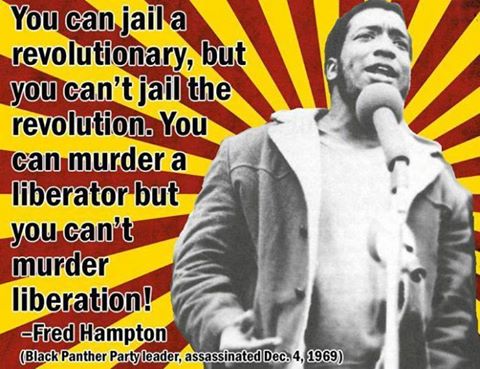
Let's really study these videos, mistakes and all, and try to build on the positive things we learn from them.
Saturday, December 3, 2016

Working-class life in Oregon: A graphic from the Daily Kos archive and a few facts on Oregon's economy


All of the following stats come from recent Oregon Employment Department reports.
- Firefighters: roughly 3,800 firefighters work in Oregon.
- Police officers: Oregon has 5,200 police and sheriff’s patrol officers.
- Doctors: about 65,700 health care diagnosing and treating practitioners were employed statewide.
- Veterinarians: we have 1,420 veterinarians in the state.
- Chefs: about 1,600 chefs and head cooks work in Oregon.
- Construction workers: 70,500 construction trades workers were employed in 2014.
- In Oregon, there were 122 sewing, needlework and piece goods establishments in 2015.
Concrete figures on which Oregon jobs pay near-minimum wage.

There are four occupations that employ more than 15,000 workers at wages below $10 per hour: fast food prep and serving workers, waiters and waitresses, cashiers, and retail salespersons.
The top 20 occupations with the greatest numbers of jobs below $10 per hour account for two-thirds of the lowest wage jobs. Together these occupations employ about 133,000 workers at hourly wages below $10 per hour.

There are four occupations that employ more than 15,000 workers at wages below $10 per hour: fast food prep and serving workers, waiters and waitresses, cashiers, and retail salespersons.
The top 20 occupations with the greatest numbers of jobs below $10 per hour account for two-thirds of the lowest wage jobs. Together these occupations employ about 133,000 workers at hourly wages below $10 per hour.

Salem's NAACP Sponsored A Meet-And-Greet Last Night
It has felt to me since the election that we are in one long and never-ending meeting and that the longer this meeting lasts the more people we lose and the less able we are to act. There is no sign that this will end anytime soon. With that in mind, then, it was good to go down to Bentley's last night for the Salem NAACP's new officer meet-and-greet and socialize a bit.
Many new and unfamiliar faces were present. I am happy to see a friend from the Muslim community attending more of these events and people engaging with him. I am thankful to the NAACP for their ability to bring people together and not have top-heavy political messaging. I'm glad that these events draw a multi-class crowd and that we have the opportunity to consolidate relationships over time and that new people showing up adds to the exciting mix.
A spectrum of political opinions were represented last night. Bud Pierce, the Republican challenger in the Governor's race, was there, as were Keizer's chief of police and a number of Black pastors, all of whom fit comfortably into the right-wing or conservative side of the political spectrum. Tom Andersen and Peter Bergel and others around them formed a kind of liberal front. Over time we are seeing the liberal and conservative forces form relationships in a negotiated comfort zone. Let's hope that this benefits us all. And there were a few of us radicals there, of course. I think that the most interesting group in the room are the folks who are simply trying to navigate the political and social terrain, people with no obvious political bent and with diverse interests. Among them are many people who have a genius and an ability for, say, math or logic or education. Interesting and good people!
It is also interesting to me who does not show up for these events. If Bud Pierce is showing up, why isn't Kate Brown? If our current mayor can take a public stand for racial justice, where is our incoming mayor in all of this? Tom Andersen says that he is, or will be, the lone liberal on city council; where are the other city councilpersons? Can we get people from the other communities of color to show up? And, most importantly, what about the Black working class in the county?
It was a great evening thanks to the efforts of Marilyn Williams, Benny Williams, Reggie Hendrix and the folks who make the NAACP work every day. We can celebrate our recent victory at City Council and we have many battles ahead of us.
Many new and unfamiliar faces were present. I am happy to see a friend from the Muslim community attending more of these events and people engaging with him. I am thankful to the NAACP for their ability to bring people together and not have top-heavy political messaging. I'm glad that these events draw a multi-class crowd and that we have the opportunity to consolidate relationships over time and that new people showing up adds to the exciting mix.
A spectrum of political opinions were represented last night. Bud Pierce, the Republican challenger in the Governor's race, was there, as were Keizer's chief of police and a number of Black pastors, all of whom fit comfortably into the right-wing or conservative side of the political spectrum. Tom Andersen and Peter Bergel and others around them formed a kind of liberal front. Over time we are seeing the liberal and conservative forces form relationships in a negotiated comfort zone. Let's hope that this benefits us all. And there were a few of us radicals there, of course. I think that the most interesting group in the room are the folks who are simply trying to navigate the political and social terrain, people with no obvious political bent and with diverse interests. Among them are many people who have a genius and an ability for, say, math or logic or education. Interesting and good people!
It is also interesting to me who does not show up for these events. If Bud Pierce is showing up, why isn't Kate Brown? If our current mayor can take a public stand for racial justice, where is our incoming mayor in all of this? Tom Andersen says that he is, or will be, the lone liberal on city council; where are the other city councilpersons? Can we get people from the other communities of color to show up? And, most importantly, what about the Black working class in the county?
It was a great evening thanks to the efforts of Marilyn Williams, Benny Williams, Reggie Hendrix and the folks who make the NAACP work every day. We can celebrate our recent victory at City Council and we have many battles ahead of us.
Friday, December 2, 2016

Thursday, December 1, 2016
Frank Rosen---A Life Well Lived

It seems to me sometimes that young people are lost or shut out as they try to find a place on the left and can't locate themselves in a particular tradition or an area of commitment and work. It doesn't help that there are so many people creating false dichotomies in polemics, like "identity politics" versus "class" or "revolution" versus "reform,' and making the left look like a mean, ugly and crisis-driven place hidden away in a very small tent. The older generations I knew as a young person are long gone, and many of them left us with a sectarian spirit or with understandable fears created under McCarthyism. Those of us growing old now, and especially those of us in and around the labor movement, should not repeat the past.
Frank Rosen---union organizer, activist and freedom fighter---died on November 28. An account of his life's work is an owner's manual on how to navigate life as a radical. The following is from the Bill of Rights Defense Committee website:
Frank Rosen, longtime labor leader, political activist, and member of the Defending Dissent Foundation board, died November 28, 2016 in Chicago where he spent most of his life. He was 91. Rosen took part in many of the seminal moments in Chicago history, from studying nuclear physics under Enrico Fermi, to fighting to defend civil liberties in the McCarthy era, to the civil rights and anti-Vietnam War movements, to electing Harold Washington as mayor, to organizing against the unregulated power of utility companies, all while helping thousands of members of his union struggle on a daily basis for decent wages and benefits and dignity on the job.
Following 15 years as a rank-and-file member of the United Electrical, Radio and Machine Workers of America (UE) and ten years on the union’s national staff, Rosen served as the elected president of UE District 11 from 1976 until his retirement in 1990. Throughout that time Rosen worked closely on many social justice issues with other leaders of the left wing of Chicago’s labor movement, led by the likes of Charlie Hayes of the Packinghouse Workers, who later became a U.S. Congressman.
Read more here.
A tentative good step toward galvanizing action and strengthening the spirit of resistance in the mid-Willamette Valley
From a great local activist and organizer:
Several community organizations were represented by one or several members – including the Racial Justice Organizing Committee, Mano a Mano, Latinos Unidos Siempre, Progressive Salem PAC, Climate 350, and Salem Social Justice Collective. There were several teachers present – from Roberts and other high schools – and staff members of the state of Oregon, Willamette University, and union members, all, of course, acting as individuals and not representatives of their organizations. Over all, there were about forty people in attendance. Ages ranged from a junior in high school, frustrated about her inability to vote in the recent election, to several retired people.
The meeting, facilitated by Quick and local organizer Mimi Khalili, began with a long, but potentially necessary period of introductions. Attendees introduced themselves with a wide range of identities, backgrounds, experiences in organizing and activism, and interests. Many were new to Salem, and just as many expressed that they had lived here for a very long time, and felt rather isolated in what they perceived as a conservative town. After the first series of introductions, Khalili asked the group if anyone would like to share their personal experiences with hate crimes or targeting, encouraging sharing because everyone could learn something by hearing one another’s experiences. She started by talking about how she had personally experienced racism and targeting since she was a child. Several others spoke up – mostly women – and told stories of harassment, violence, and abuse of force from citizens and law enforcement, some from farther in the past, and some having occurred in the most recent weeks. One woman told a particularly disturbing story of police officers tackling and handcuffing her father outside of his own apartment building in the middle of the night.
After sharing these experiences, the group moved on to begin to discuss the potential for action and organization. The majority of attendees seemed to not be currently attached to an organizing group, and were looking to find like-minded people to work with. This may have contributed to a lack of direction once the group began discussing how to proceed tactically. There also was a shift in space and speaking, as the balance in the conversation shifted to mainly older white men sharing their ideas and designs. One woman spoke up and suggested that everyone acknowledge and consider their positionality and be cognizant of the space they take up in the room. Everyone in the group seemed to appreciate this sentiment, although it can sometimes be a struggle, especially in large groups, to moderate the presence of voices. There were a few times when people suggested that the role of this organizing group should be focused on the current administration, but there was definite pushback to the idea that racism, violence, and systemic inequality were somehow new, or unique to our present political situation. Several folks also addressed their concerns with broadly organized networks and coalitions in the past, and emphasized the need to develop some time of internal structure.
The discussion became rather side-tracked for a while on discussing what the name of the group should be. Eventually, this decision was tabled for the next meeting. One woman spoke up bravely and pushed back against the word “progressive,” because, as she movingly stated, she associated that word with people and movements that seem to be leftist, but repeatedly and continually abandon and ostracize undocumented people from their struggle. After a bit of encouragement from two other individuals to acknowledge the significance of those statements, everyone was moved to assert that the presence, support for, and defense of undocumented people would be an intrinsic part of any Salem coalition. There will need to be a lot of action to stand behind those words, however, to make up for how “progressive” movements have failed marginalized people in the past.
In terms of tangible, productive steps, one attendee volunteered to create and send everyone in the room a survey regarding their goals and thoughts for the name, organization, role, and focus of the group. Kai Blevins volunteered to create a google doc and group that everyone could share and contribute to. This group would include a shared calendar that could be used to keep track of actions, meetings, rallies, fundraisers, etc. all over the Salem area. Several attendees also suggested planning efforts begin in Salem to organize a protest for inauguration day.
As is par for the course for an initial meeting, it wasn’t the most efficient or focused gathering, but there seemed to be a healthy amount of energy, commitment, and ideas – as well as enough folks ready to resist succumbing to watered-down, neo-liberalism type ideas. As the meeting came to a close, we set a date for the next meeting – December 14th – assigned two new facilitators (myself and Peter Bergel volunteered), agreed to send out google invites and surveys, and accepted the offer of one attendee to translate the next meeting into Spanish in order to start following through on making the group accessible and welcoming. For the next meeting, I believe it will be useful to initially address some concerns about dominance and power in group settings, and establish a self-imposed rule for how many times you should contribute to a conversation in order to not shut others out. I think it will also be imperative to address, before names or other logistical details, the nature of the group as a whole: will this be a “coalition” that simple acts as a network communicator and resource builder, connecting people to already existing organizations, helping facilitate volunteers, numbers, capital, etc? Will this be a group of individuals? What will the goals be? How precisely do these goals need to be defined? Is this group focused on community support and defense, or policy change?
Overall, this meeting seemed like a tentative good step toward galvanizing action and strengthening the spirit of resistance in the mid-valley.
Subscribe to:
Posts (Atom)