Friday, May 6, 2016

Boston Socialist Unity Project conference aims at left cooperation

From People's World:
BOSTON - Local poet John Greenleaf Whittier once wrote, "So long as Boston shall Boston be, and her bay tides rise and fall, shall freedom stand in the Old South Church, and plead for the rights of all."  Fittingly, this historic venue opened its doors on Saturday, April 30th, for the first conference of the Boston Socialist Unity Project (BSUP1). It was an extraordinary gathering of local and regional activists for a day full of learning and sharing, of theory and practice - all focused on building the movement for a society based on dignity and human rights for all.
Seeking to bring about unity through collective projects and educational events, BSUP1 was held under the theme: "Building Socialism. Building Our Movements." It brought together socialists and activists from a variety of organizations in the Boston area to discuss common areas of work and ways to strengthen each other's efforts in the long-term goal of replacing capitalism with a more just economic and social system.
See the full article here.

How should we think?---Part 3


This is our third in a series on how thought and action intersect in the peoples’ and workers’ movements. For us this is less a matter of a correct process leading to correct ideas, although that needs to happen, and more a matter of constantly trying to use critical thinking and dialectical materialism to improve our thinking processes, and then our actions, and then examining our actions and changing course if necessary. The only people who don’t make mistakes are the dead. What often matters most is how we correct our course and apply what we’re learning to new situations.

We start with the two clips above because we agree that consciousness and identity are basic links to where we start in our thinking process. Granted that we struggle with all kinds of incorrect ideas, if we’re using critical thinking skills we are at least aware of our general interests and biases as we begin our acting-thinking-reflecting-acting process. Understanding and situating ourselves as oppressed people---as workers, women, people of color, LGBTQIA+, differently-abled and so on---and developing a consciousness of our situation deepens our abilities to act correctly. I can’t function correctly in the world if I don’t understand my place in it and my relationship to the world. I can’t be in solidarity with people of color if I don’t have a grasp of the objective relations between whites and people of color and my own relative privilege. Understanding my place in the world and my relationship to others in the world requires hard data and an on-going analysis of that data. As I understand my position as a worker I understand that the working class is the dialectical opposite of capitalism. The action-thought-action paradigm moves us forward if we work with it dialectically.

We also start with these clips because what is being said in them can be adapted to any oppressed group and to the working class---I was a part of the working class before I was born---but the particularity of who is speaking here and how they are speaking are all-important. The Black revolutionary tradition forces us to understand that history is an ever-unfolding project moving from conditions of “unfreedom” to liberation, that there are stages in this development, that people develop in real time and in history. We’re lost if we don’t understand and give full weight to the particular historic moment that we are in and we are lost if we lose contact with what the Black freedom struggle has to teach us about this. When Marx said that white labor will never be free while Black labor is enslaved he was speaking pragmatically as much as he was speaking philosophically, making a hard point about dialectical materialism.

This introduces us to three concepts.

One is that we do not properly operate from a place of making change because change is a good or moral necessity, true as that is. We make change because human development in real time---that is, lived human history---is always full of possibilities, and the best actions are those which work to continue the movement from unfreedom to freedom, from inability to ability, from lack of agency and responsibility to empowerment.

The second concept is one of interests, which takes us back to self-consciousness: if I understand that I am a worker and/or an oppressed person, and if I understand something of my history and have the knowledge that things can change radically, then I will work from a place of collective self-interest. I will commit to working with other working-class people for social, economic and political programs which move all of us forward because this forward movement captures the unfolding historic process of liberation and blocks the backward movement that social forces hostile to us are set upon. And as I enter the world of engagement I learn that my liberation is tied directly to the liberation of others because of the threads that connect us as human beings, and as human beings with certain relations to capitalism; this is, how we stand in relation to how goods and services and social relations are produced, reproduced, distributed and managed. I also learn that there are core forces and reserve forces in this struggle for liberation.

The third concept that is introduced here is that oppression and exploitation are both simultaneously qualitative and quantitative. That is to say in short that the qualitative conditions of the capitalist society that I live in----how relatively sophisticated and complex production, distribution, administration and social relations are in the US---determines the main conditions of my oppression, and that this can be quantified by looking at how much surplus value I produce at work and in what units and over what periods of time, and what it costs to reproduce my ability to work and consume. Alongside of this, where I stand in relationship to others and in relationship to privilege and to imperialism can also be quantified, and the specific quality of where I take my place and the relationship of my place to others can be determined. These determinations, if they are correctly made and understood, are what describes my relative exploitation and oppression. And this exploitation and oppression, though relative to others, is a fundamental aspect of capitalism, although the lines can move and matters can get better or worse for us.

Capitalism once affirmed the dignity, rights and independence of segments of the entrepreneurial classes and a certain trickling down did take place. The entrepreneurial classes were the people who wrote the Bill of Rights and the Constitution, led the American Revolution and claimed the victory of the Civil War. There was a certain affirmation and validation of human power and agency under early capitalism, however incomplete or hypocritical or short-lived that it was. The debates over Constitutional principles that we have today reflect the incomplete nature of the capitalist revolution and the system’s consequent hypocrisy.

Capitalism has come to negate human will and freedom, choice and democracy even as it has created material conditions which have brought us to the edge of quantitative and qualitative changes which signal real historic advances. This snowball-rolling-down-the-hill effect created two all-serious contradictions: the forward-moving material conditions created by capitalism work against it, and capitalist development brings us to the edge of world destruction. These are not matters of economic and political policy: they go to the heart of capitalist economic and political relations. The unfolding of these relations and contradictions has been dialectical.

We can say, then, that capitalism has passed from a stage of affirmation to negation. The processes of capitalist production, reproduction and distribution now negate the labor power that was harnessed to bring them into being. Human freedom and the environment are negated as necessary laws of capitalism. The creation of the working classes and the enslavement of peoples for capitalist development was the creation of capitalism’s opposing core forces. A for-profit system necessarily sets upon degrading and destroying the environment both in its methods of production and distribution and by making nature and human nature abstract. If nature and human beings appear as opposites under capitalism then there will be a war between the two. The false human triumph over the environment, over nature that is really us and what is around us and within us, ends badly for both.

When we take action in defense of the oppressed and the environment, however short of the mark we may be, we are negating capitalism---that is, we are negating the negation of human life, freedom and the environment. If we create a mass socialist movement and birth socialism then we are counter-posing an affirmation to a negation. If we privilege or stay in the place of counter-posing a negation to a negation, which describes the failure and crisis of anarchism and nihilism, or if we place ourselves at the margins of society or above social conflict, which are the failures of the Greens and pacifists and counter-cultural forces, we either get nowhere or move backwards. In either case we are going against the flow of history. This is a brief and almost vulgar explanation of dialectics applied to social relations.

Thursday, May 5, 2016

How should we think?--Part 2

In our previous post on thinking we took a generally critical and negative approach in order to call out situations where the absence or suppression of critical thinking has hurt workers' and peoples' movements. In this post we will take a more positive approach.

The German poet Bertolt Brecht described the foundation of good thinking in his poem Praise of Learning":

Study from bottom up,
for you who will take the
leadership,
it is not too late!
Study the ABC; it is not enough.
but study it! Do not become
discouraged,
begin! You must know everything!
You must prepare to take command,
now!
Study, man in exile!
Study. man in the prison!
Study, wife in your kitchen!
Study, old-age pensioner!
You must prepare to take command now!
Locate yourself a school, homeless folk!
Go search some knowledge, you who freeze!
You who starve, reach for a book:
it will be a weapon.
You must prepare to take command now.
Don’t be afraid to question, comrades!
Never believe on faith.
see for yourself!
What you yourself don’t learn
you don’t know.
Question the reckoning
you yourself must pay it
Set down your finger on each small item. asking:
where do you get this?

You must prepare to take command now!

If you get what Brecht is saying here, and especially where he is telling us to put our hands on things and ask how they got here, and if you can carry this out in your daily life with others, then you have advanced beyond critical thinking. For most of us, however, these are new and very radical concepts and the US left has yet to love and serve the people enough to transmit these concepts in positive ways.

We use critical thinking skills so often that we overlook these skills, don't sharpen them and then give in too easily to others who don't have our best interests at heart. For instance, if you have ever had the opportunity to consider whether or not you would go on strike you are familiar with the calculations that workers make about the forces in play and their relative strengths and weaknesses, how solid each side is and how the opposing sides stand in relation to one another, who will hold out and who won't and who has credibility and who doesn't. Many workers correctly take this thinking into politics as well.

A less dramatic example might be a person deciding whether to take on a bully or not. The decision is based on an estimate of forces at work, risks, suffering and possible outcomes. In both cases a certain weighing of interests and options takes place based on available information and an understanding of the real differences between people and their relative strengths and weaknesses.

There is something almost scientific in both of these situations. Good critical thinking will carry people through these situations most of the time, and over time most people will develop self-confidence and the capacity to think and do much better, but there are tremendous pressures in society working to convince you that you can't do this. And critical thinking, by itself, is not wholly sufficient for us. We say this because our critical thinking often misses the mark of understanding and defining naturally opposing interests and the possible outcomes of the struggles which occur between diametrically opposing social forces, and because our critical thinking often can't withstand the pressures which work against it in irrational capitalist society.

We start at the radical point of saying that workers and employers have nothing in common and that this basic difference echoes through all social relationships---between men and women, between people of color and white people, between people who experience oppression and people who don't. The opposition or contradiction between workers and employers is fundamental to capitalism, even when relations appear to be harmonious, and is based on capitalism being a system of legalized and anarchic theft in the workplace and at the point of consumption: workers do not get the full return and benefit from what we produce, we sell our ability to work just as any other commodity is sold, our wages and benefits only signal the costs of maintaining and reproducing our ability to keep working, every new "labor-saving" method and increases in productivity also increases the rates and depths of our exploitation, and we pay doubly for this system as workers and when we purchase needed and desired commodities. Conflicting interests are built into the system and there is no escaping this. People who see a commonality of interests between workers (labor) and bosses (capital) have a tremendous burden when called on to explain themselves.

Critical thinking may start at the point of grasping these fundamentally opposing interests and values, but it usually doesn't. And when we say that the only logical conclusion to the struggles that occur as a result of the opposing interests set into motion under capitalism is socialism many critical thinkers will object and take refuge in time-worn arguments that put critical thinking aside. A consistent critical thinker will not turn to arguments about human nature or the USSR and will not misquote socialist thinkers when confronted with a modern argument for socialism, but many people do.

We see critical thinking as a tool and as a necessary step which enriches human beings, helps move people forward through daily struggles and more complex social conflicts and challenges stale and oppressive orthodoxies. We go further, however, and say that what is needed is a constantly occurring and dynamic thought-action-reflection-action process which puts human experience at the center and focuses on interpreting the world and changing it. We laid out in our previous post what we think are the building blocks to this approach---dialectical materialism.

I can hear criticism coming as I write these words: we are mechanistic and old-school in our thinking, God will take care of everything, this is whitesplaining or mansplaining, we are saying that everything is reducible to class and capitalism, that workers and employers have much in common.

About God we can say little. A dialectical materialist understanding of false religion says that religion serves a purpose in comforting and deluding the oppressed and upholds the social order as an ideology and that "real" religion recognizes "salvation" as dependent upon a god acting with human beings in the context of an unfolding and liberating process. We admit and make the self-criticism that we engage in whitesplaining and mansplaining and that we often don't pay heed to this because of capitalist logic and privilege. We try to take this on in our daily work and we try to compensate for our errors by being open to correct ideas and impulses arising from other oppressed people.

The criticism that we are mechanistic in our thinking has a certain historical basis. Our communist movement spoke for several generations about the "inevitability" of communism and took for granted the existence of large socialist blocs which no longer exist. Our line and (mis)understandings were not correctly applied and then criticized and reoriented. We wrongly believed that quantity and quality necessarily contradict one another. We wrongly asserted that there are not antagonistic contradictions under socialism. We have not resolved the question of whether or not a new thing divides into two opposing forces or incorporates two contradictory forces or trends into it. These are not arcane philosophical questions---they are matters that, in one form or another, every socialist force has to grapple with.

The criticism that we blame all problems on capitalism and believe that socialism will settle all accounts and claims is incorrect. Contradictions will continue under socialism, will take new forms and may rise to the points of being antagonistic contradictions. And we do not say that the abolition of capitalism will settle contradictions between people of color and white people or between women and men. Rather, we look to those points where identities meet or cross today and we depend on the people at those crossings to eventually lead all oppressed people forward. Racism, sexism, homophobia, transphobia, speciesism and ableism all have destructive lives of their own as well as specific contents under modern capitalism. Taking them apart depends on the directions and leadership provided by core social forces at the intersecting points of oppression, our ability to take responsibility for our own learning and action and the reconstruction of society on the basis of social, productive and reproductive relations which build collective work and ownership.

The matter of opposing class interests is especially hard to take up in the US. A separation exists in our perceptions which does not admit a direct and determining connection between the base operations of capitalist society and what is built on that base. We say that there are no poor people here, just temporarily embarrassed millionaires. We think that citizenship dissolves all other identities into a democratic whole and we let citizenship eclipse these identities, effectively disappearing ourselves; our exploitation and oppression become political causes to be worked out, not the roots and branches of capitalism to be overthrown. We see alienation as a psychological problem, and not as a basic aspect of capitalism brought into existence with the mass production of commodities made for a market economy. We talk about precariousness as a by-product of capitalism and not as something essential to the system. All of this is mistaken. All of the bosses, most of the politicians and most labor "leaders" and the mass culture industries collude in order to diminish our class consciousness and bind us to the system.

We ask our readers to review and consider the brief lists given in our first posting on thinking in light of this second post. We also suggest that readers consult these sources for on-going study:

1. Fundamentals of Marxism-Leninism, edited by Otto Kuusinen and Clemens Dutt and published in the USSR.
2. The Theses on Feuerbach by Karl Marx
3. Foundations of Leninism by Stalin
4. Four Essays on Philosophy by Mao
5. What is Dialectical Materialism? by V. Krapivin
6. On Historical Materialism by Franz Mehring
7. On The Correct Handling Of Contradictions Among The People by Mao
8. Woman and Capitalism: Dialectics of Oppression and Liberation by Angela Davis
9. The Weapon of Theory by Amilcar Cabral
10. Pedagogy of the Oppressed by Paulo Freire
11. Dialectical Materialism by Alexander Spirkin

You can also go here to view an expanded reading list.

And if you still don't think that you're getting it, put your hand on the Brecht poem and ask: how did this get here?

Wednesday, May 4, 2016

How should we think?---Part 1

Critical thinking is, or should be, a rigorous means of analysis, assessment and reflection most often used to solve problems and build a discipline of thinking and action. Most proponents of critical thinking talk about the primacy of observation, experience, and reason as guides for belief and action. A distinction is made between beliefs and values, and biases are acknowledged. Critical thinking draws on the hard sciences in its work.

Critical thinking has its critics. People who operate solely from a place of faith have different methods of getting to their conclusions, people who see the acquisition of knowledge as an end in itself will not stretch into critical thinking, people who emphasize negation or conflict or who privilege contradiction above all else will not see a need for critical thinking and people who are good with a command/control paradigm will discount critical thinking.

Our group and this blog tries to take up questions of interest to the socialist movement, national liberation struggles, the labor movement and everyone fighting for liberation. Some of us frequently find ourselves at odds with others on the left and engaged in struggles over specific issues of theory and practice. I think that many of these differences are more rooted in how people think than in what we ultimately want. I want to explore some of these problems of thinking in a few posts.

Most of my experience is in the labor movement and as a worker and as a union staffperson. Over the years I have seen an absence of critical thinking in the labor movement, a real inability to analyze, assess and act on the basis of firm values. There is an unwillingness to confront and deconstruct problems, pull them apart, examine their sources and map a way forward based on real data and science. And not only that---union leadership is often threatened by members and staff who do think critically and who bend towards collective solutions based on collective and disciplined thinking. We can say that if the leaderships are not actually threatened by members in motion in this way then they do most often try to harness this energy to a particular political or contract campaign, devaluing thinking and action over the long haul or as a value that can be carried by “ordinary” workers into everyday life. And certainly very few unions teach or model critical thinking skills.

There are exceptions, of course. The UE, NUHW and NNU unions all do at least some critical thinking on the local and regional levels and don’t block members and staff from taking up critical thinking. The closer a union is to social movements like the civil rights movements, the Latino/a struggles and popular education models the more that union will privilege critical thinking. These social movements have gone very far in strengthening critical thinking and critical thinking skills. And perhaps it is so that white people---and most union leaders and staff are white---have a distance from these movements and have to work extra hard to “get it.” It may also be a matter of white people having distance from, say, the kinds of experiences and thinking which led Bernice Johnson Reagon to write If You Don’t Go, Don’t Hinder Me---a deceptively simple book that shows critical thinking and a dialectical approach to history in real-time action.

If we must be results-oriented here then let’s look at where the absence of critical thinking in the labor movement is taking us. At SEIU union staff are constantly engaged in assessing the union membership: do members fit into the union’s program or not, are they good with following the leadership or not, can they be moved in a particular direction or not and who can move them? Members are scored by staff based on assessments.

Assessments may be a basic feature of union organizing, but when making assessments are subordinated to real conversations between equal partners, and a union program then exists above and beyond the lived experiences of workers, we end up with clique-driven organizations that are incapable or unwilling to think about and take up issues which stretch across the entire working class. Problems may be “solved”---or bandaged---for some period of time for a particular group of workers, but working-class life still lurches from crisis to crisis. We set about managing the crises instead of solving the problems, and as we do this our numbers naturally diminish.

Perhaps another example will help. We have a large bloc of Sanders supporters who are unwilling to think in terms of building a united front against the far-right and unwilling to work on forcing Clinton to take more responsible and left positions, we have a Democratic party establishment using below-the-belt tactics against the left and being unwilling to back progressive-left candidates, we have a weak liberal center shifting incrementally to the right and we have a divided left which has not consolidated around a principled program based on organizing the people and fighting back. The Democratic establishment under Obama, and many of the union leaderships, and some other social forces worked to demobilize us with Obama’s first election and then to mobilize us when he ran again, and this mobilizing undercut organizing. It sought to replace real organizing with either e-mail protests or acquiescence. We have lots of activists and busy people but very few organizers, and activism is proving to be allergic to critical thinking. When some politicians and union leaders can’t make principled arguments for weak positions they substitute polling for leadership. None of this builds fighting capacity, and it is fighting capacity which builds numbers and victories.

We aren’t pulling apart and critically examining the core problems----capitalism, racism, oppression--in science-based ways. The crises we’re in gain much of their power and momentum because we can’t see the balance of the quantitative and qualitative forces at work and then go into motion in ways which confront these crises head-on. Unions tend to step into the vacuum and try to manage or ameliorate the crises; sometimes this works for the good, but more often it doesn’t---and it never builds real unin power. We say that all working and oppressed people need to learn thinking and action skills and need organizations willing to take on the big fights based on an analysis put forward by the workers, the oppressed and our allies.

Sounds abstract and difficult, doesn’t it? We will try to break it down in future posts.

Our basic assumptions and points here are:

1. The lived experiences of people matter.
2. People develop complex class, race and gender-based relations over time.
3. Within these relations there are inevitable contradictions which emerge over real time.
4. Some of these contradictions are necessarily antagonistic and some aren’t.
5. Understanding these relationships, the balances of power and the social contradictions at work is a kind of science.
6. Critical thinking is a tool used in grasping this science, but it is not enough.
7. There are correct and incorrect ideas.
8. We best learn what is correct and incorrect through lived experience and we determine truth based on social relations and through collective processes.

The principles to keep in mind here are:

1. The quality of a thing must be studied.
2. The quantitative features of a thing must be studied.
3. Transitions between the quantitative and qualitative must be understood.
4. Development occurs through a confrontation or struggle between opposing forces.
5. A necessary tension exists between the passing of the old and the emergence of what is new.
6. We prioritize practice, or activity, in determining what is correct and incorrect.
7. Practice, or action, lays a basis for theory, theory is tested in practice and then changes in light of our reflection and practice. Practice tests theory and truth.
8. There are necessary tensions between truth and opinion and between absolute and relative truth. There is also a unity between absolute and relative truth.

When we say “thing” here we are referring as much to objects and items as we are to society and struggle and to the labor and social change movements. Please think about how these principles impact you in your real daily work.

Tuesday, May 3, 2016

Several of us attended the Sanders rally in Salem this evening. Here is the text of a leaflet we gave out at the rally:

The Sanders movement has done a great job in changing the national conversations on wealth, power, race and foreign policy. “Socialism” is no longer a word to hide from and progressive alternatives are being debated everywhere. For the first time in many years we have a real electoral option and the opportunity to make a case for change before the American people. The field is full of genuinely progressive candidates like Dave McTeague who can help carry a people-before-profits program through if they can win support from workers, young people, people of color and women.

Even if Sanders and other good candidates lose, there will be no going back from this historic moment. A stronger foundation now exists for winning a higher minimum wage and workers’ rights, rent control, equal rights for all and defeating racism and sexism, real immigration reform, a peoples’ budget and money for healthcare and education and not for wars and occupations. We support these goals and work for them every day.

Still, the political campaigns remain weak on foreign policy, racism and sexism, trade policy and immigration. Sanders and the candidates running with him need a firm push from the people in these areas. Real internationalism needs to replace foreign policies driven by short-term American interests and trade deals. White, male and heterosexual privilege needs to be defeated. The door needs to be opened to women, youth and people of color in every area. Strikes and worker resistance to corporate power need to be encouraged and supported. The passions which built the Occupy movement, the civil rights and womens’ movements, the environmental movement, the immigrant rights movement, gay liberation and union organizing need to be continuously reignited and every politician must be held accountable for their relationship to these movements.

Social change takes time and effort. We win when we organize and fight back.

Salem socialists meet monthly and participate in many social justice efforts in our community. We maintain a blog at http://oregonsocialistrenewal.blogspot.com/ and a Facebook page. If you consider yourself on the left and friendly to socialist ideas, please contact us at_____


Friday, April 29, 2016

A few words to the Left

It has been a long time since anyone posted on our Oregon Socialist Renewal blog. We need to renew this work and better describe who we are and what we do as socialists.

Our Salem, Oregon group has people in it who are involved in their unions, in local racial justice work, in political campaigns, in environmental projects, in trans awareness and rights struggles and in the kinds of activist-driven community campaigns that are hard to label or describe. We are working-class people, we’re non-hierarchical and we show up at rallies and do the work of the rank-and-file. I think that we listen to people and that we have our feet on the ground. We are in worksites, in the union offices and on the streets and in the housing complexes and in the social justice groups every day learning from people and talking to them. Most of us come to this place with strong backgrounds in organizing, and it is this focus on organizing which moves us forward, even if it is in fits and starts.

On the other hand, we are not very focused, we don’t function collectively much of the time, we don’t study together and we find agreement and cohesion more by accident than through a more deliberative process. We have found ourselves in several national organizations over the years, the latest being the Committees of Correspondence for Democracy andSocialism (CCDS).

CCDS has not had much effect on our praxis over the years. I wish that matters were turning out differently, but our ties to CCDS have only meant real ties to our comrades in Corvallis and to a few others. CCDS as a national organization seems either set to dissolve or to shift to being an educational effort. We, on the other hand, have wanted something which would assist us in local organizing, connect us directly to people in our region doing work similar to what we do and be supportive of our international work. Some of us have hoped for a more politically-driven and centered organization with a cadre more focused on political organizing and party-building; CCDS is not that organization. When a few of us have tried to develop stronger ties to CCDS we have felt frustrated. On the other hand, we have not used the great CCDS educational resources that are available and we have not been able to put time aside to participate in the discussions underway about the organization’s future. Participation in these conversations has been inhibited by technology and schedules which have not worked for us.

We are currently discussing how we can help sponsor and build a series of socialist conferences which have the ability to carefully consider our options and build a larger and more cohesive regional socialist presence.

We also notice---and we have experienced this in our group many times over the years---a widespread tendency on the left and in social movements to function without real commitment and accountability. People take on responsibilities and then drop out soon after, people show up to “sample the goods” but don’t commit, there is a culture here of making political work transactional and an unwillingness to take our ideas out to others, people get bored by bureaucratic union meetings and don’t return to fight for a militant program, there is an inability to think dialectically, mansplaining does great damage, there is not a love of the people and a willingness to serve the people.

This mix of positives and negatives, frustrations and walls, false starts and reinvention might be common on the left these days. We don’t know because we don’t have enough contact with other left groups. I often ask other people on the left what they actually do day-in and day-out---how they organize, what their daily praxis is---and get vague answers. It seems to me that many people on the left live in a kind of self-imposed exile, not willing to reach beyond the walls that we have constructed around ourselves. We also have many people on the left who have put aside their politics in order to work in liberal movements, for unions and in non-governmental organizations and these folks are incredibly busy, often too busy to think through what they’re doing and what they’re about.

The people who aren’t organizing and mobilizing spend a great deal of time on social media trying to convince us that our daily work is futile and misdirected, while the folks buried in the liberal groups and unions work very hard to convince us that every compromise is a step forward and that class struggle and revolutionary demands are destructive. If the people in the first group are super-attentive and come to what they do with something like laser-like intensity, quick to criticize and correct, the folks in the latter group most often drop the ball, don’t return calls and e-mails and show up to use and derail movements when they feel that this is the necessary course to follow.

I am describing matters with a certain flourish, not in great detail and not mindful of all of the complexities involved. I want to mention in passing that there are many groups which do not fit into these categories. Freedom Road and the All-African People’s Revolutionary Party, whatever their differences and whatever disagreements we may have, have risen far above the common left experience. The Sanders campaign has helped build the Democratic Socialists of America---certainly not one of our favorite organizations---into something with a real presence and base. We have no direct ties to the KentuckyWorkers League or to the Southern Workers Assembly, but both seem to be saying and doing the right things. The continuing success of Labor Notes and the stabilization of the workers’ rights centers movement also point in good directions. We take from these groups the lesson that we win when we fight back. What we need here are the people willing to commit to fighting back and seeing the struggles through.

Sanders’ politics stop where mine begin, and I am often put off by the naïve white men in the Sanders movement who want to preach revolution to me, but the Sanders movement has helped shift almost everything to the left in the US. It is hard to imagine that we will see a rollback or that conditions will return to normal even after Sanders loses the nomination, and even if he endorses Clinton. We have come very far in a short period of time, and this journey has not been particularly spontaneous or driven solely by reformism. There is the critique that the Sanders movement owes its energy to the Occupy movement, but I think that its roots are more properly located in the Jackson campaigns or, for that matter, in the Henry Wallace movement. There is the ultra-left critique that Sanders is ultimately the same as Clinton, but this seems simply wrong and misdirected. There are important policy differences between the two candidates, but the real difference is in the quality and quantity of the campaigns; Sanders has a movement and Clinton has a campaign, Sanders attracts some of the most politically engaged forces at the grassroots while Clinton manipulates those forces. And there is the reformist argument that Sanders has declared the start of a political revolution all by himself, that corporate money and Citizens United are all that stand between this revolution and its victory, that it is the concentration of wealth that matters more than any other social questions. The reformist argument is extremely naïve, perhaps willfully so, and it dovetails with the Clinton argument that real change isn’t really possible.

As the Sanders movement loses its collective naiveté in the face of hard struggle a certain number of Sanders’ followers are bound to walk away disenchanted and burned out. They will take Clinton’s point that we have to settle for less, if they are willing to engage with politics at all at that point. My concern is with those people and also with the most politically engaged folks backing Sanders; they both need a radical alternative based in a revolutionary praxis which loves, serves and organizes the people.

The Sanders movement has done a great job in changing the national conversations on wealth, power, race and foreign policy. “Socialism” is no longer a word to hide from and progressive alternatives are being debated everywhere. For the first time in many years we have the opportunity to make a case for change before the American people. And the field is filling up with progressive candidates like Dave McTeague who can help carry a people-before-profits program through if they can win support from workers, young people, people of color and women.

Even after Sanders and some of the best candidates lose we will have a stronger foundation for winning a higher minimum wage and workers’ rights, rent control, equal rights for all and defeating racism and sexism, real immigration reform, a peoples’ budget and money for healthcare and education (and not for wars and occupations). Our group supports these goals and works for them every day.

The political campaigns remain weak on foreign policy, racism and sexism, trade policy and immigration. Sanders and the candidates running with him need a firm push from the people in these areas. Real internationalism needs to replace foreign policies driven by short-term American interests and trade deals. White, male and heterosexual privilege needs to be defeated. The door needs to be opened to women, youth and people of color in every area. Strikes and worker resistance to corporate power need to be encouraged and supported. The passions which built the Occupy movement, the civil rights and womens’ movements, the environmental movement, the immigrant rights movement, gay liberation and union organizing need to be continuously reignited and every politician must be held accountable for their relationship to these movements.

When I talk to people on the left about this---and particularly with people who are ultra-left---I hit a very stubborn refusal to work with the people and the peoples’ movements. With Verizon workers on strike and the Communication Workers of America (CWA) officially backing Sanders, there is a historic opportunity for the left to learn and to build, to break out of our confines. It would be opportunistic to jump into the struggle later with a list of criticisms. It would be sectarian to stand on the sidelines and sit out the necessary fights. It would be elitist and sectarian to try to influence matters from a distance and without a base among the workers and in the Sanders campaign as well. Still, these are relatively strong tendencies on the left. These tendencies developed over years of isolation from peoples' struggles and from not having a dialectical understanding of how movements function. Also, the misunderstanding that there is a contradiction between quantity and quality has been widespread on the left for many years, and this has worked out in a way that distrusts any large movement that is not narrowly and explicitly revolutionary.  

The US left left does not come to this place by accident. We have not grasped dialectical materialism, we have no leading left party or left front, we did not consolidate forces before Obama was elected, we were demobilized by corporate Dems and by people on the left who saw more in Obama than is there, we allowed a certain distance to grow between the left and the Black working-class masses, and we’re not generally about building principled united fronts. None of this is to our credit.

So a major union in basic industry (CWA) is on strike and that union has officially endorsed Sanders. I am a leftist. I can do any of the following. Which should I do?

1. Get on FB and rant about Sanders and union leaders selling-out. It's easier than doing anything else.
2. Go down to the rally and the picketline and sell my paper and hand out my leaflet telling everyone the Truth. It's the only way workers will ever learn anything.
3. Identify the political level of the most advanced workers and tell them what they need to know. Then I can get back on FB and go back to my group and feel like I've done something.
4. Work on delegitimizing unions, Dems and the rest of the left who I disagree with. I know better than they do 'cause I've studied this stuff for a few years and have read some great books. Fighting with people I disagree with creates ideological clarity, and everyone is depending on me to do this.
5. Think about what skills it would take to get a job in basic industry, acquire those skills and become someone in a workplace who coworkers respect and then use that position to build a group and organize from.
6. Go to the Sanders and union meetings, participate in the most basic ways so that I learn organizing skills, listen to what people are talking about and work together with them to find solidarity. Dedicate myself to talking to 3-5 people every day who do not share my politics and making 80% of those conversations listening.
7. Find some compromise positions among a number of labor and community groups that I'm in that everyone is good with, build political power in my workplace/neighborhood and help use that power collectively to change power dynamics and fight the right and racism from where we are.
8. Continue on with things like Occupy, the Greens and inner-left battles because that has all proven to be so successful so far. After all, its the movement from the margins and the periphery that changes things.

A closing point: we need to ask ourselves what we are willing to critique and give up in our praxis, throwing out whatever it is that puts distance between ourselves and the people we need to win over.

Monday, January 18, 2016

What is socialism?


On our Facebook page, someone commented:

I can’t buy into this model. This sounds like communism, and that’s a flawed system. As Orwell pointed out in “Animal Farm,” there will always be a hierarchy. There will also always be a need for creators to conceive and develop businesses and industries and the monetary incentive for them to create. Those creators deserve their due, just not at the expense of the workers who help to bring their ideas to fruition and provide the intellect and labor for its continuation. Ideally there is a partnership that benefits both – capitalism at its best. But people being people, exploitation is inevitable, which is why we need government regulation, minimum wage, unemployment insurance and unions - a blending of capitalism and socialism.

Our response:

Well, we're socialists and communists so don't be surprised if something here "sounds like communism" because it is or probably is. "Always" is a long time and we don't want to predict the future or use Orwell as some kind of bible or guide to human nature. We can't buy into saying that anything is inevitable, and particularly exploitation. And of all the incentives to do well, money must surely be among the worst. Hierarchies come and go. It's one thing to elect or appoint hierarchies, hold them to criticism/self-criticism and put them aside when they have served their purpose. It's another thing entirely to have a hierarchy imposed on you, as capitalism does. Besides, most human activity can take place without hierarchy and bureaucracy. Since capitalism is at its essence a system of institutionalized theft I don't think that it can be blended with anything and have good results. It's labor that creates wealth and not the other way around. The problem is that capitalism itself functions inevitably at the expense of the workers because profit derives fundamentally from not paying the workers for the full value of what they produce; if capitalism did that it would not exist. Can you show us where such a blending as you want has taken place and where partnership works on equal terms on a long period of time or where there have not been either crises of overproduction or under-consumption in any capitalist country?


Thursday, July 2, 2015

Denouncing 'Corporate Democrats

Published on Wednesday, July 01, 2015 by Common Dreams

Denouncing 'Corporate Democrats,' Labor Leader Joins Sanders Campaign

Larry Cohen, outgoing president of Communications Workers of America, cites Hillary Clinton's sidestep on Fast Track in decision

Hillary Clinton's hedging on Fast Track has pushed at least one labor leader to Bernie Sanders' 2016 presidential campaign. (Composite photo: Senate Democrats/flickr/cc, keith kissel/flickr/cc )
Larry Cohen, the labor leader and outgoing president of the Communications Workers of America (CWA), is officially backing Bernie Sanders' 2016 presidential campaign—at least in part thanks to Hillary Clinton.  Cohen will reportedly serve as an unpaid volunteer for the U.S. senator from Vermont, who is running on a platform of progressive issues like workers' rights and campaign finance reform, among others.

Cohen told the Huffington Post on Wednesday that he made his choice after Clinton, who is currently the frontrunner for the Democratic nomination, continued to evade questions from the media and consumer watchdogs over her stance on Trade Promotion Authority, also known as Fast Track—a bill that gives President Barack Obama expanded power to push pro-corporate agreements like the Trans-Pacific Partnership (TPP) through Congress without input or amendments from lawmakers.

Fast Track passed Congress last week. Obama signed the legislation into law Monday. "I did everything I knew how to do to get Clinton to speak out on fast track, and she wouldn’t," Cohen told HuffPo. "We begged her to speak out." HuffPo continues: "Bernie is movement-building, and we need a new movement."
—Larry Sanders, CWA

Cohen, a staunch progressive, said Clinton's handling of the trade issue helped clarify why he wanted to get behind Sanders, whose candidacy is still considered a long shot despite standing-room-only crowds he's been drawing early on the trail. Sanders has been a vocal critic of giving Obama fast-track trade authority.
“Without a candidate like Bernie, we’re going to get a repeat of the same stuff," Cohen said. "Bernie is movement-building, and we need a new movement. We need to get big money out of politics."
While the CWA has not publicly endorsed a candidate for president, the union came out strong against Fast Track and the TPP. In April, before the legislation passed Congress, Cohen called on lawmakers to "put the brakes on Fast Track."
Cohen said: "TPA pretends to be about trade, but in reality it is about protecting corporate profits above all else and defining our national security in terms of giving away our jobs, depressing our wages and then rewarding the responsible multinational corporations, often U.S. based, with guaranteed profits in the nations where they invest."

The labor leader will officially announce his support of Sanders at a campaign stop in Council Bluffs, Iowa later this week. "The key is him being the progressive candidate," Cohen told HuffPo. "You build the movement—you don't just inherit it from labor or any other tent."  And Clinton's hedging on Fast Track "won't be forgotten," Cohen added. Organized labor is "not a rubber stamp for the Democratic Party and certainly not for corporate Democrats."

Monday, June 15, 2015

Turkey's President Erdoğan is isolated as Rojava's People's Defense Forces (YPG) liberate Tel Abyad/Girê Spî

Rojava's People's Defense Forces (YPG) liberating Tel Abyad/Girê Spî

Reposted from Harvest.
 
Yesterday we talked a bit on this blog about the crisis the Turkish government is experiencing in this new period after the June 7 elections and as the liberation movement moves to take Tel Abyad/Girê Spî from ISIS. Since Tel Abyad/Girê Spî is on the Turkish-Syrian border, and since that border crossing has helped ISIS resupply, Turkish President ErdoÄŸan and his government have been put in a tight spot. A new refugee crisis has added to those problems. The liberation movement took Tel Abyad/Girê Spî today and the border at Akçakale and Girê Spî/Tel Abyad is now under the control of Rojava’s People’s Defense Forces (YPG) and the Liwa Al-Tahrir forces tied to the Free Syrian Army (FSA).
 
These events must be among the Turkish President’s nightmares. He only recently said, "On our border, in Tel Abyad, the West, which is conducting aerial bombings against Arabs and Turkmens, is unfortunately putting terrorist members of the PYD and PKK in their place.” The PYD is Rojava’s Democratic Union Party and the PKK is the Kurdistan Worker’s Party. Erdogan can see no further than this and his remarks may be understood as either supporting ISIS or as preferring that ISIS be at the border rather than the Kurdish freedom movement and Rojava’s democratic forces. ErdoÄŸan and some in his government went even further by accusing the West of backing "Kurdish terrorists" in northern Syria, charging that the refugees from Tel Abyad/Girê Spî were fleeing the anti-ISIS bombings being carried out by US-led coalition forces and initially refusing to open the border to the Tel Abyad/Girê Spî refugees as they suffered in 95-degree heat without water or shade while ISIS forces sought to take some of them as human shields.
 
ErdoÄŸan's government, already battered by the June 7 election results which allowed the progressive People’s Democratic Party (HDP) to enter Parliament as a party, is taking quite a hit under these new circumstances. We have argued here that ErdoÄŸan and his government support ISIS, actively or passively, and now these forces are being routed by the liberation movement. The government has done almost nothing over the past 48 hours which will reassure the leading imperialist powers. Indeed, it is clear that the government’s ability to do crisis management has suffered.
 
ISIS must now withdraw to Raqqa and find other supply routes. The US-led coalition airstrikes may continue and aid Kurdish forces, whether this is intended or not. Revolutionary Rojava can unite their cantons and continue to build a peoples’ democracy. We have maintained that it is this revolutionary democracy, led as it is by women and by popular forces, that poses the fundamental problem for ErdoÄŸan's government and ISIS. Even as the center of the fighting now moves to Raqqa, the contest between revolutionary democracy and fascism deepens. ErdoÄŸan might have positioned himself as a regional leader firm in his opposition to ISIS and similar forces, but with the passing of time the liberation movement has instead gained credibility in the west. Cizîrê Canton Public Services Vice Minister Newroz Muhammed was exactly right when she recently said that the international community is well aware that no problems in Syria can be solved without the Kurdish forces.
 
ErdoÄŸan has been to tell the pro-government media outlets that the YPG is deliberately targeting the indigenous Arab and Turkmen population in northern Syria and that Rojava and the YPG are threats to Turkey’s national interests. Some of these views have been echoed by the powerful and reactionary Ahrar al-Sham and Jaish al-Islam organizations in Syria, and by some allegedly liberal groups and people in the Kurdistan Regional Government as well, in a cynical effort to divide the liberation movement and the forces gathering around it as ISIS is forced to retreat. The false claim has been made that "YPG forces ... have implemented a new sectarian and ethnic cleansing campaign against Sunni Arabs and Turkmen under the cover of coalition airstrikes which have included bombardment, terrorizing civilians and forcing them to flee their villages" by these forces. Even the United States has distanced itself from such remarks. The YPG has liberated more than 500 Kurdish and Christian towns and strategic positions and have pushed into Raqqa province.
 
Turkish interference in Syria continues and is part of the crisis. The Cumhuriyet and Birgün newspapers have both recently exposed links between the ruling reactionary Justice and Development Party (AKP), ErdoÄŸan’s party, and ISIS in northern Syria. Turkey’s National Intelligence Organization (MİT) at one point transported ISIS fighters through the Akçakale border gate to fight against the YPG and allied forces. ErdoÄŸan’s immediate maneuvers have been to again attack the media and the judiciary.
 
Today ErdoÄŸan went even further and said, “But if the party that came first in the election cannot achieve (forming a government) and neither can the second one ... then going to the ballot box again as per the constitution would be inevitable. I don’t call this a snap election, but a re-run.” In other words, the President is not coming to terms with the new political reality in Turkey which brought the HDP into Parliament, created something like a political stalemate in government and showed the weaknesses of the AKP after 12 years in power. This new reality is driven in part by struggles taking part across the region, Syria included, and by the enthusiasm generated by Rojava’s advanced revolution. For that matter, it is also driven in part by Turkey’s 10-per-cent-plus unemployment rate and high inflation rate as well, which are very much related to the regional conflicts. A rerun of the last elections would be an undemocratic and power-grabbing move which might well further undermine ErdoÄŸan and his AKP.
 
The situation or crisis in Syria went on the agenda for a cabinet meeting today while a liberal Republican People’s Party (CHP) leader finally stated the obvious---a government can now form in Turkey without the AKP. The fascist Nationalist Movement Party offered to cooperate with the AKP in forming a government but put forward conditions ErdoÄŸan is unlikely to agree to since they potentially expose graft and corruption in his party and government. He started with a program that argued for a more powerful presidency at the expense of Parliament and an authoritarian security package that the AKP passed through Parliament over the objections of the democratic forces. He may soon be floundering as Rojava’s revolution expands and as the crises in Syria and Iraq intensify and as the most democratic forces in North Kurdistan and Turkey advance.


Thursday, June 11, 2015

The Audacity to Win: A Call for Strategy for the US Left

Posted by admin on June 11, 2015 under Socialism, Strategy | Be the First to Comment
By Left Strategy Collective Members
 
May 30, 2015 – There is something bubbling beneath the surface in the US. Everyone can feel it. Everywhere there are mass actions – on issues ranging from fast food workers’ rights, to deportations, from the latest police killing, to community displacement, from defending collective bargaining, to getting clean water, from getting the water turned back on, to ending the occupation of Gaza.
 
There is something bubbling, but the question remains whether it will evaporate into steam or explode like a volcano. Capitalism confronts people all over the world, including the US, and its crises implicate the very survival of humankind. Yes, there are sprinkled victories, hopeful uprisings, and electoral surprises, but we know in our hearts it is not enough.
 
We go to sleep with the question, "When and how?" When and how will the tables turn? When and how will we become a force in US politics and win power? When and how are we going to be able to change the nature of the field we are forced to play on? In order to address these questions, we need a strategy for the left. We will refer to "the left" here as those forces that oppose the capitalist, white supremacist, hetero-patriarchal system and seek to build an alternative society.
 
In this paper, we will make the case for the importance of strategy, we will lay out our definition of strategy and the components we believe are necessary for the building a game- changing strategy for the left. We would like to see the development and implementation of a strategy for power –where the oppressed are able to determine their own livelihood and how society functions. This strategy would necessarily be aimed at an emancipatory transition from capitalism.
 
This paper will not be the strategy. It is a contribution to the many left voices that are calling for the need for strategy, and to begin to build a shared language of what strategy is. We are a small core of leftists from different sectors of the movement. We do not believe that we alone can build this strategy. However we have some thoughts about what is to be done and we have a commitment to building the space to develop this strategy with like-minded leftists. Our hope is that the process of engaging in this level of strategy development will promote a new movement culture of more intentional, collective, and focused movement development that will bring us to game-changing victories and power that will transform this country.
 
WHAT IS STRATEGY?
The act of developing strategy should result in more than a political line, a political program, or a new organization. It will not be enough to have a clever slogan. It will not be enough to focus on a single task, tactic, or campaign. The type of strategy that is necessary to build among leftists would: 1) imagine and formulate a vision of an alternative to capitalism; 2) analyze the current conditions both on our side (the working class, organized forces, and the left overall) as well as the opposition (the ruling class and the capitalist state); and 3) work toward that vision through devising a continually evolving program that would strengthen the forces for liberation and weaken the capitalist forces on an economic, political, and ideological scale to the point of "putting it out of business" all together.
 
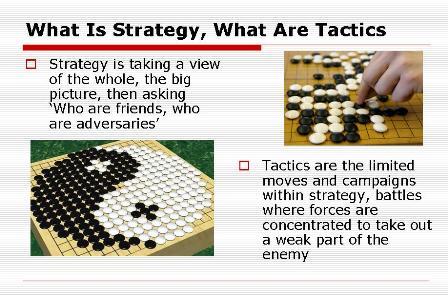
Tactics are different from strategy. Tactics are the specific types of actions we take to execute our strategy. The series of actions may make up a particular program, but they are not the entirety of our strategy. The strategy will determine plans, to be put into action, evaluated and summed-up. It will not be based on what worked in one city and then applied to a different city with completely different conditions. It will not be based on our personal moods, whims, or the flavor of the month. It will not be a mere goal with no way to achieve it. Goals are the aims that our strategy is built around. It will be a comprehensive approach that includes our analysis of conditions, our hypothesis of how we will build power and win. This strategy becomes a living course of action that is implemented, tested, summed-up, evaluated, and reworked. (Continued)
A football team has a strategy. (We are not pretending here that the NFL with all its contradictions is the extent of the totality of the strategy that the left needs, but it offers some helpful analogies.) A football team knows their players very well– their strengths and their weaknesses. They know how the overall the team works together. After a game they look at reel footage of their previous games, where mistakes were made, and successes were gained. They work to strengthen their team and play to its strengths. Likewise we need a full assessment of our social forces for change. Maybe there are communities who have not been organized yet. We may need to "draft them" (or rather organize them).
 
In preparation for an upcoming game, the team studies their future opponents, the weaknesses that they can take advantage of, the capabilities of that team that maybe our team cannot match but can out-maneuver. They come up with plays to defeat their opponents that are both offensive and defensive. We need that playbook for the left. We need to be looking for and identifying opportunities to shift the correlation of forces, that is, the social forces for change as well as the opposing forces that maintain the current state of affairs. Understanding the correlation of forces allows us to interpret why our forces are losing and why the opposing forces are winning, and maneuver accordingly. In Marta Harnecker’s paper, Instruments for Doing Politics, she explains that what we are pinpointing in this process is, "the relationship between the capacity that one force has to impose its interests on an opposing force and the capacity that the opposing force has to do the same." Knowing who’s on the opposing team, what they are capable of, what their weaknesses are, and the same of our team, aids us in our planning.
 
Football players and coaches must understand the objective conditions. Objective conditions are the reality of the situation we are in, and the realities of the actors in play. If they are playing at the Lambeau Field, the Green Bay Packers’ outdoor stadium in Wisconsin, they will be in extreme cold and it’s likely that it will snow. The team must prepare for how these conditions will affect their performance. A coach can also look objectively at their stats of players and determine their strengths and weaknesses. We can also look at our stats, where we have had wins and defeats, and what were the conditions we played in.
 
But this metaphor only takes us so far. The process of developing our strategy ultimately needs to identify what "game" we are going to play. What is our theory of transition? How do we believe we can defeat capitalism given the conditions, and forces we face? What is our alternative vision for society? Knowing where we are headed will help us determine this path. Toward that end and with the analysis of the correlation of forces in mind, we are also analyzing and identifying what the primary issue or contradiction we must address in a given time, place and conditions and the vision of the transformative change we want to see in this area, as well as to shift the balance of forces and win more power. It is identifying what type of formations and tactics will allow us to wield the most power to win and implement our plan. Then we will go back and look at the "reel" – constantly summing up and evaluating.
 
We therefore propose the creation and implementation of left strategy aimed at building power and ultimately ending capitalism and winning a just, sustainable, and emancipatory future. This process of building strategy must take on developing a rigorous analysis, with hard numbers and an honest assessment of the correlation of forces. The strategy will identify primary contradictions that in the process of struggle will move us to gain more power, and win transformative changes in society. It identifies the formations and tactics based on analysis that will get us to victory. Strategy is a continuous process. Once a developed strategy is employed, we are continuously evaluating and taking what we have learned in action, towards modifying the strategy and applying these lessons toward the development of future plans. To borrow from Harnecker, "Strategy is the way that diverse battles are planned, organized and directed to achieve our goal."
 
WHAT DO WE HAVE TO DO TO DEVELOP STRATEGY?
 
Strategy for what? Defining Our Goals
The strategy we are referring to relates to a struggle for power between those who own and control the economy and politics of this country, on the one hand, and the working class and vast majority of the U.S. people, on the other. For many of us, this is a struggle for our very survival and for some, a matter of life and death. The struggle for power against such a formidable adversary requires precision and clarity at each stage along with meticulous definition of what our goals are.
A vision of a new society will inform how we approach developing strategy.
 
While a full elaboration of such a vision is outside of the scope of this paper, we offer some thoughts about a new society. We need a vision of an alternative to capitalism which will 1) develop the capacities of human beings to live full, creative, healthy lives, and 2) achieve social ownership of the means of production focused on production for human need rather than profit, 3) reorient production towards meeting social needs and protecting the earth, 4) free workers to guide and plan their own productive work.
  
Human development must be the enduring measure of a socialist alternative to capitalism. A socialist government would facilitate planning the production and distribution of socially necessary goods with the active participation of the working and popular classes through a framework centered around solidarity, efficiency, internationalism, environmentalism, engaged protagonism and human rights. Human development must be understood as development which respects and protects our planet’s ecology. Considering the repair and survival of the planet’s health in constraining methods of production and use of natural resources as a means of achieving human development, allows us to ensure longevity of the planet and human survival.
 
In summary, we have argued that strategy building is a critical aspect of left work. We defined and characterized what strategy is, and identified elements of a strategy building process. These elements of strategy building include the identification of the social forces at play, the contradictions between such forces, the correlation or balance of forces, and the objective conditions under which the strategy has to be crafted so as to shift power towards a new society envisioned by the left.
We also wish to raise a few flags that are important to keep in mind as we undertake the strategy building project. For one, this work must be undertaken alongside bringing together a range of concrete data – demographic and social – that will give us a grip over the real nature of the objective conditions. Further, such work must not be individual driven and will involve the bringing together of meaningful collective(s) of movement activists and socially grounded intellectuals as also a clear understanding of the scale and scope of the work. Finally, the strategy building process must be seen as organically connected to consciousness raising and the dynamic articulation of our vision.
 
WHERE DO WE GO FROM HERE?
As activists working inside the United States, we know that the lead role that the U.S. has played and continues to play in advancing imperialism means that any viable left alternative must not further the subjugation and exploitation of the peoples of the global south, but rather must be built in collaboration with revolutionary forces organizing against U.S. imperialism around the world and must be thoroughly anti-imperialist, internationalist and act at all times in solidarity with the world’s peoples.
 
In this paper, we of Left Strategies argue that developing strategy is crucial to achieving both short-term reforms and revolutionary transformation of our society. We have sketched out an initial approach (or methodology) and raised some of the questions around strategy theory and development that are necessary to move forward. Strategies that we develop don’t have to (and won’t be) perfect. As we work together to develop and test strategies, the lessons we will learn and the progress we make will encourage us. We want all of us to engage in a movement- wide discussion and debate on the importance of strategy and how we can work together to develop it. This is a call to action. Developing left strategy is not an academic exercise. It is a way to enhance our ability to win. Successful left strategy will make our organizing more effective and build the leadership of the masses in struggle. We all must be in the streets to support the struggles of all those who are under attack. But we cannot fall prey to pragmatism which would limit our ability to strategize and take maximum advantage of the more favorable balance of forces our organizing is producing. It is up to us have the "audacity to win" a new society for the majority of people in the U.S.
 
-Left Strategies Collective* members: Rishi Awatramani, Jake Carlson, Bill Fletcher Jr., Jon Liss, Garry Owens, Biju Mathew, Merle Ratner, Claire Tran, Helena Wong o A longer version of this paper will be forthcoming.
Feedback: We look forward to hearing your feedback. If you agree with us, please give us your suggestions on how can we move forward on strategy work. If you disagree, please tell us why and how you would approach the situation in which our movements find themselves.
In either case, we’d like to hear about any strategies your movement has tried and what you have learned from implementing them.
 
You can contact us by emailing leftstrategies@gmail.com [1]
 
* The Left Strategies Collective was founded to create conversation within the Left around strategy development. Between 2013-2014, the Left Strategies Collective conducted a number of national calls bringing people together to talk about issues such as Worker Organizing in the 21st century, and Lessons from the Moral Mondays movement.

Sunday, April 19, 2015

Unity & Struggle

The journal Unity & Struggle #29, organ of the International Conference of Marxist-Leninist Parties and Organizations, is available. It includes an article from the Party of Labor (EMEP) of Turkey, “Confusion and Disintegration in the Middle East,” analyzing the role of U.S. imperialism and Islamic fundamentalist groups in disrupting the anti-imperialist and democratic movements in the area.

Also available is an article “Chile and the Road to Socialism,” by the ML Party of Germany criticizing the “peaceful road” to socialism during the Allende period. It includes an independent introduction analyzing the role of revisionism in the CPUSA and CPSU regarding Chile.

The journal and the article are both available, for $5 and $2 respectively (postage within U.S. included), from:

George Gruenthal
192 Claremont Ave. #5D
New York, NY 10027
georgeg0626@hotmail.com


Please make check or money order out to George Gruenthal

Wednesday, April 8, 2015

NLG Calls for Immediate, Independent Medical Attention for Mumia Abu-Jamal

Author: Tasha Moro
Tuesday, April 7, 2015
National Lawyers Guild

FRACKVILLE, PA--The National Lawyers Guild (NLG) calls on the Pennsylvania Department of Corrections to give NLG Jailhouse Lawyer Vice President Mumia Abu-Jamal immediate independent and specialized health care, including his choice of medical specialists.

On March 30, Mr. Abu-Jamal collapsed in the prison infirmary at SCI Mahanoy from diabetic shock before being hospitalized in the ICU at Schuylkill Medical Center. Despite his serious condition, he was transferred back to the prison just two days later. Although he had sought care for classic warning signs of the disease over the previous three months, including extreme weight loss and severe eczema, the prison infirmary had failed to diagnose him with type 2 diabetes which, with proper medical attention, could have potentially prevented Mr. Abu-Jamal’s current illness.

The medical attention given to Mr. Abu-Jamal thus far has been administered without adequate information and has raised questions of medical neglect, as it was only after a flood of calls by activists and supporters to officials at SCI Mahanoy that he was allowed a handful of very brief visits by family. His family and attorneys are demanding he see a diabetes specialist and dermatologist who is independent of the Pennsylvania DOC health care system.

“Mumia’s medical situation is serious, he remains at risk, and must be allowed immediate and independent medical care without further delay,” said NLG member Bret Grote, attorney for Abu-Jamal. “We applaud the thousands of supporters worldwide who have called the Pennsylvania DOC demanding immediate medical attention and visitation rights for Mumia and encourage people of conscience to continue doing so until demands are met,” he added.

“Abu-Jamal’s voice and his political analysis have guided our work to end racially discriminatory mass incarceration. Now we must speak up for him, as he confronts yet another problem endemic to US prisons—lack of adequate health care,” said Pooja Gehi, Executive Director of the NLG.

Imprisoned for the killing of a police officer more than 30 years ago, Mumia Abu-Jamal is an award-winning journalist and author whose case and writings about the criminal justice system from inside prison have garnered international attention. A former Black Panther, the NLG has long maintained that Mr. Abu-Jamal’s case has been from the outset, plagued with procedural irregularities and blatant constitutional violation, and that he is entitled to a new and fair trial.

Take Action:

Read, sign, and share this petition [1] by Mumia’s supporters, including a list of demands.
Contribute toward lifesaving medical care and other costs incurred by Mumia’s family at bit.ly/rise4mumia [2].

Call the following numbers to demand immediate, independent medical attention for Mumia. Please mention that you're calling regarding Wesley Cook #AM8335 (as Mumia is registered with the DOC).

SCI Mahanoy
Superintendent John Kerestes
(570) 773-2158

SCI Mahanoy
Chief Health Care Administrator Steinhardt
(570) 773-2158

Christopher Oppman
Director, PA Department of Corrections Health Care Services
(717) 728-5309

John Wetzel
Secretary, PA Department of Corrections
(717) 728-4109
- See more at: http://portside.org/print/2015-04-08/nlg-calls-immediate-independent-medical-attention-mumia-abu-jamal#sthash.DFAMl07y.dpuf

Thursday, April 2, 2015

Don't Let Congress Sell Out Workers for Corporate Profit

Defend worker and human rights by taking action to stop Fast Track and trade deals like TPP.  Don't let Congress sell out workers for corporate profit. Learn more about the dangers of Fast Track and TPP here. Go to this link to view a brief video: "TPP: The Dirtiest Trade Deal You've Never Heard Of." Call Congress today using this special union number: 1-855-712-8441.